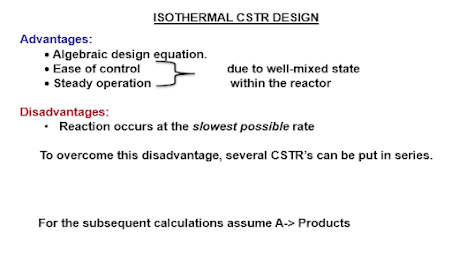
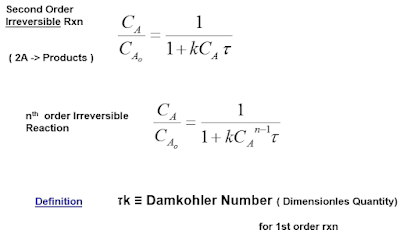
The following is a summary of reactor design equations discussed in previous entries:


The following is a summary of reactor design equations discussed in previous entries:
The Temperature-Specific Volume Diagram
To
obtain this diagram we repeat the process discussed in the last blog entry
(Click Here) at different pressure values. The resulting curves for water look
as shown below:

It
can be observed that with increasing pressure the horizontal line connecting
saturated liquid and saturated vapor states becomes shorter. The reason is
that as pressure increases, the specific volume of saturated liquid increases
and the specific volume of the saturated vapor decreases. At P = 22.09MPa, the
horizontal line between the saturated liquid and vapor states shrinks to a
point at which the constant pressure line forms an inflection point with a
slope = 0. This point is referred to as the critical point.
At
a critical point, the saturated liquid and saturated vapor states are
identical and the temperature, pressure and specific volume of a substance at
this point are called the critical temperature, critical pressure and critical
volume, respectively. When the pressure is above the critical pressure, a
liquid and vapor phase of a pure substance does not exist in equilibrium.
The
saturated liquid states can be connected by a line called the saturated
liquid line while saturated vapor states are connected by a line called
the saturated vapor line. These two lines meet each other at the
critical point, forming a dome as shown:

All
the subcooled liquid states are located in the region to the left of the
saturated liquid line ad is referred to as the subcooled liquid region.
All
the superheated vapor states are located to the right of the saturated vapor
line and this is called the superheated vapor region.
In
these two regions locates outside the dome, a pure substance exists either in
liquid or vapor phase (single phase)
The region under the dome is called the saturated liquid-vapor mixture region where the liquid and vapor phases are in equilibrium.
The
Pressure-Specific Volume Diagram
For a pure substance, the Pressure-Specific Volume diagram is similar to that of Temperature-Specific Volume diagram, however, the isotherms (constant temperature) lines have a downward trend as can be seen below:

The
Pressure-Temperature (P-T) Diagram
Pure
substances can exist as solids, liquids or as a vapor. The P-T diagram is a
graphical method of showing the effects of pressure and temperature on the
phases of a pure substance. It is referred to as the phase diagram with the
three phases separated from one another by three lines as shown:

The
curve that separates the solid and vapor phases is called the sublimation
curve, and along it the solid and vapor phases are in equilibrium. The
slope of the sublimation curve gives the rate of change of sublimation pressure
of the solid with temperature.
The
curve that separates the solid and liquid phases is called the fusion (or
melting) curve, and along it the solid and liquid phases are in
equilibrium. Its slope gives the rate of change of melting or freezing of solid
with temperature. The fusion curve has a positive slope for most substances but
water has a negative slope.
The
curve that separates the liquid and vapor phases is called the vaporization
curve, and along it the vapor and liquid phases are in equilibrium.
Its slope gives the rate of change of vapor pressure of liquid with
temperature. This curve ends at the critical temperature and pressure of the
substance.
At
temperatures and pressures higher than the critical values, substances are called
supercritical fluids i.e., they exist in the fluid (or supercritical)
region. They possess both the gaseous properties (viscosity, diffusivity, surface
tension) of being able to easily diffuse into substances, and the liquid
property (density) of being able to dissolve substances.
When
P < Pc, a substance in the gaseous state is called either a gas (T
> Tc) or a vapor (T < Tc). Under isothermal
conditions, while a vapor can be liquefied by exerting pressure, a gas cannot
be liquefied regardless of what pressure is applied to it. That is, a pure gas cannot
be liquefied at temperatures above its critical temperature no matter what
pressure is applied to it.
On
the phase diagram, the point where the solid, liquid, and vapor phases coexist
in equilibrium is called the triple point. This is where the liquid-vapor
(vapor pressure curve), solid-liquid (fusion or melting curve), and solid-vapor
(sublimation pressure curve) coexistence curves intersect. The number of
degrees of freedom at the triple point is zero.
Since
the fusion curve generally has a very steep slope, the triple point temperature
for most substances is close to their melting (or freezing) temperature at
atmospheric pressure and this is known as the normal melting (or
freezing) point.
A pure substance is a substance that has a fixed chemical composition throughout. It can exist in more than one phase, but the chemical composition must be the same in all phases. An example of this is ice-liquid water mixture and liquid water-steam mixture.
Scenario:
Let us consider a system consisting 1 Kg of liquid water in a piston cylinder
apparatus as shown below. Assume that the ambient pressure and the piston
weight maintain the cylinders pressure at 0.125MPa with the initial temperature
at 25°C.

At the initial conditions (P = 0.125MPa, T = 25°C), water is a called subcooled liquid i.e., it will not vaporize if heat is transferred to the system.
When heat is transferred to the water, its temperature increases significantly and the specific volume increases slightly while pressure remains constant.
When T = 105.99°C, the additional heat transfer results in the water boiling and a phase change occurs. A liquid that is about to boil is referred to as a saturated liquid.
When the liquid is vaporizing, its pressure and temperature remain constant but its specific volume increases. At this point it is called a saturated liquid-vapour mixture where both liquid and vapour phases coexist in equilibrium.
When all liquid vapourizes, only vapour exists in the cylinder and is called saturated vapour. Any heat loss from a saturated vapour leads to condensation.
An increase in heat into a saturated vapour leads to an increase in both temperature and specific volume and its called a superheated vapour.
This
whole water heating process at a constant pressure can be represented on a T - Ṽ diagram as shown below:

At any given pressure, the temperature at which a pure substance boils is referred to as the saturation temperature (Tsat). While at any given temperature, the pressure at which a pure substance boils is referred to as the vapour or saturation pressure (Pvap). For a pure substance, there is a definite relation between the vapour pressure and the saturation temperature which results in a vapour pressure curve shown below. The boiling of a pure component starts when the Pvap = Ambient Pressure. This explains why water boils at a temperature less than 100°C at a mountain top.

Dimensionless Groups or numbers are relationships with no units of measurement and are often used in chemical engineering.
There are numerous
dimensionless numbers used by chemical engineers and this blog entry discusses
the more common ones. The equations below are all in metric units, however, if
you use consistent units, the dimensionless numbers remain unchanged.
This is arguably the most commonly used dimensionless group in chemical engineering. It gives a measure of the ratio of inertial and viscous forces in fluid flow and is often used to determine if the flow is either laminar or turbulent:
The Reynolds Number can be calculated using the following equation:

Where:
When calculating Reynolds Number, the
units used are not important but MUST be consistent. For pipes or channels with
circular cross-section, the characteristic dimension can be taken as the pipe
diameter.
For flow through pipes, Reynolds Number
below 2000 indicates laminar flow while a Reynolds Number above 4000
indicates turbulent flow. Reynold Numbers between 2000 and 4000 indicate
transitional flow i.e., rapidly changing between laminar and turbulent
flow.
This is the ratio of kinematic viscosity to the thermal diffusivity. Prandtl Number can also be defined as the ratio of momentum and thermal diffusivities. It tells us how fast the thermal diffusion occurs as compared to momentum diffusion in fluids. It is used in many calculations involving heat transfer in flowing fluids, as it gives a measure of the relative thickness of the thermal and momentum boundary layers. It can be calculated using the following equation:

Where:
It should be noted that the Prandtl number is dependent on the fluid’s physical properties alone and hence it is often found in physical properties.
For many gases (with the notable exception of hydrogen), the Prandtl number has a value of 0.6 to 0.8 over a wide range of conditions. If the Pr << 1, then thermal diffusivity dominates and when Pr >> 1, then momentum diffusivity dominates
This is the ratio of convective to conductive heat transfer in a fluid over a given length, L:

Where:
For heat transfer in pipes, the characteristic length is the pipe diameter.
When Nu ≈ 1 then convection and conduction are about equal. Typically, this occurs in laminar conditions. As the Nusselt number becomes larger, convective heat transfer becomes relatively more important – this occurs as the flow becomes more turbulent.
The mass transfer equivalent of the Nusselt number is the Sherwood Number discussed next.
This is a measure of the ratio of convective and diffusive mass transfer in a fluid. It is analogous to the Nusselt Number in heat transfer and summarized as shown:
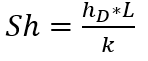
Where:
It is a measure of the ratio of the inertial and gravitational forces and can be expressed as:

Where:
It
is often used to analyze fluid flow problems on a free surface. For example, in agitated vessels, Fr governs
the formation of free surface vortices:
This is a ratio of the buoyancy and viscous forces. It is used to calculate heat transfer in natural convection where the fluid velocity depends on buoyancy. It can be expressed as:

Where:
This is the ratio of the fluid velocity to
the velocity of sound in that medium. It
can be expressed as:

Where:
In Chemical Engineering, the Mach Number
is commonly used in calculations that involve high velocity gas flow.
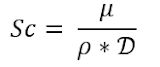
This is the ratio of kinematic viscosity to the diffusivity and it characterizes mass transfer in a flowing fluid. It can be expressed as:
Where:
It is the ratio of the internal thermal resistance of a solid to the
boundary layer species transfer resistance. It can also be defined as the ratio
of internal conductive resistance to the external convective resistance. It is
represented as shown:

Where:
Biot Number helps analyze the interaction between conduction in a solid and convection at its surface. Smaller Bi number values signify that conduction is dominating the heat transfer mechanism while larger Bi number values signify that convection is dominating the heat transfer process.
Isothermal and adiabatic processes are important concepts with thermodynamics and chemical engineering students should grasps these concepts, Below are some basic differences between the two processes:
|
Isothermal
Process |
Adiabatic
Process |
|
It
is a thermodynamic process that occurs under a constant temperature |
It
is a thermodynamic process that occurs without any heat transfer between a
system and its surroundings |
|
The temperature is constant |
The temperature can change |
|
Heat
transfer can be observed |
No
heat transfer |
|
Work done is due to the change in
the net heat content of the system |
Work done is due to the change in its internal
energy |
Both are some of the most important mass transfer processes used in chemical and process industries and are called sorption process. A Sorption Process is a physical or a chemical process by which one substance becomes attached to another substance. Another sorption process is Ion Exchange process.
Absorption is a process where components from a gas phase transfer into a liquid phase when the gas phase and liquid phase are brought into contact. On the other hand.
Adsorption is a process where components from a gas phase or a liquid phase are attached to the surface of a solid phase when the gas phase or the liquid phase is brought in contact to the solid phase. Adsorption is a surface phenomenon.
|
Absorption |
Adsorption |
|
The
substance penetrates the surface |
It
is a surface phenomenon |
|
Occurs at a uniform rate |
Initially the rate increases then decreases |
|
Unaffected
by temperature |
Affected
by temperature |
|
It is the same throughout the
material |
Concentration on the surface of absorbent is
different from that in the bulk |
|
It
is an endothermic process |
It
is an endothermic process |


One of the most common numerical methods used is the Simpson's One-Third Rule
Simpson’s One-Third Rule is one of the most common numerical methods. It uses three data points. One numerical method for evaluating integrals include:
Trapezoidal Rule (uses two data points)

Five-Point Quadrature Formula

When energy crosses the boundary of a system, the energy in the system changes by an equal amount. Thus a decrease in the energy of a system...