Chemical Engineering Tutorials: Dimensionless Numbers
Showing posts with label Dimensionless Numbers. Show all posts

Friday, 15 November 2024

Continuum Mechanics

Continuum Mechanics is the study of the behavior of materials by ignoring its particulate nature. 

A continuum is an area that can keep being divided and divided infinitely with no individual particles. It is a simplification that allows us to investigate the movement of matter on scales larger than the distances between particles.

In continuum, the smallest element of a fluid is NOT a fluid molecule, but rather a fluid particle that contains enough number of molecules to make meaningful statistical averages. Continuum assumes that fluid and flow properties like pressure, temperature, density, velocity, etc. vary continuously throughout the fluid.

This helps to study a wide range of phenomena, from air and water flow to even the evolution of galaxies.

For us to know whether or not the continuum hypothesis can be used, a dimensionless number called Knudsen number is used. The Knudsen number allows for characterizing the boundary conditions of a fluid flow. It is defined as:


If the length scale of the fluidic system is in the same range as the mean free path, i.e., Kn = 1, the fluid cannot be treated as a continuum.

The Knudsen number is very useful when assessing the boundary of fluid flows. Usually, the flow at the boundary of a flow field where the channel walls are fixed in space and the liquid directly in contact is considered to not be moving. This is referred to as the no-slip boundary condition, i.e., there is no relative movement (slip) between the wall and the fluid layer that directly contacts with the wall. 

According to the Knudsen number, flows can be divided into different regimes:


(a) For Kn < 0.01, continuum flow dominates and conventional fluid dynamics equations are applicable, indicating that gas molecules interact with neighboring molecules.

(b) For 0.01 < Kn < 0.1, the slip flow regime occurs when the gas molecules experience slipping at the solid interface.

(c) For 0.1 < Kn < 10, transition flow occurs. This refers to a flow regime in which both slip (continuum) and diffusion flows can occur.

(d) For Kn > 10, Knudsen's (free molecular) flow occurs. This refers to gas molecules that flow with minimal or no interaction with neighboring molecules.


Fluid Properties:

Characteristics of a continuous fluid which are independent of the motion of the fluid are called basic properties of the fluid. Some of the basic properties are as discussed below:

  • Density: The density ρ of a fluid is its mass per unit volume (kg/m3).
  • Specific Weight: This is the weight of a fluid per unit volume (N/m3).
  • Specific Volume: is the volume occupied by unit mass of fluid (m3/kg).
  • Specific Gravity: For liquids, it is the ratio of density of a liquid at actual conditions to the density of pure water at 101 kN/m2, and at 4°C.
    • For gases, the specific gravity is the ratio of its density to that of either hydrogen or air at some specified temperature or pressure.


Wednesday, 22 December 2021

Dimensionless Numbers #1

Dimensionless Groups in Chemical Engineering

Dimensionless Groups or numbers are relationships with no units of measurement and are often used in chemical engineering. 

There are numerous dimensionless numbers used by chemical engineers and this blog entry discusses the more common ones. The equations below are all in metric units, however, if you use consistent units, the dimensionless numbers remain unchanged.

Reynolds Number (Re)

This is arguably the most commonly used dimensionless group in chemical engineering.  It gives a measure of the ratio of inertial and viscous forces in fluid flow and is often used to determine if the flow is either laminar or turbulent:

  • In laminar flow, viscous forces dominate. The flow paths are smooth, streamline and constant.
  • In turbulent flow, inertial forces dominate. The flow regime is unstable, generating eddies and vortices.

The Reynolds Number can be calculated using the following equation:

Where:

  • ρ = Fluid density (kg/m3)
  • u = Fluid velocity (m/s)
  • L = Characteristic dimension (m)
  • μ = Dynamic viscosity (Pa.s)

When calculating Reynolds Number, the units used are not important but MUST be consistent. For pipes or channels with circular cross-section, the characteristic dimension can be taken as the pipe diameter.

For flow through pipes, Reynolds Number below 2000 indicates laminar flow while a Reynolds Number above 4000 indicates turbulent flow. Reynold Numbers between 2000 and 4000 indicate transitional flow i.e., rapidly changing between laminar and turbulent flow.

Prandtl Number (Pr)

This is the ratio of kinematic viscosity to the thermal diffusivity. Prandtl Number can also be defined as the ratio of momentum and thermal diffusivities. It tells us how fast the thermal diffusion occurs as compared to momentum diffusion in fluids. It is used in many calculations involving heat transfer in flowing fluids, as it gives a measure of the relative thickness of the thermal and momentum boundary layers.  It can be calculated using the following equation:

Where:

  • CP = Fluid Specific Heat Capacity (J/kg.K)
  • μ = Dynamic viscosity (Pa/s)
  • k = Thermal conductivity (W/m.K)
  • ν = Momentum or Kinematic diffusivity (m2/s)
  • α = Thermal diffusivity (m2/s)

It should be noted that the Prandtl number is dependent on the fluid’s physical properties alone and hence it is often found in physical properties.  

For many gases (with the notable exception of hydrogen), the Prandtl number has a value of 0.6 to 0.8 over a wide range of conditions. If the Pr << 1, then thermal diffusivity dominates and when Pr >> 1, then momentum diffusivity dominates

Nusselt Number (Nu)

This is the ratio of convective to conductive heat transfer in a fluid over a given length, L:

Where:

  • h = Heat Transfer Coefficient (W/m2.K)
  • L = Characteristic length (m)
  • k = Thermal conductivity (W/m.K)

For heat transfer in pipes, the characteristic length is the pipe diameter.

When Nu 1 then convection and conduction are about equal.  Typically, this occurs in laminar conditions.  As the Nusselt number becomes larger, convective heat transfer becomes relatively more important – this occurs as the flow becomes more turbulent.  

The mass transfer equivalent of the Nusselt number is the Sherwood Number discussed next.

Sherwood Number (Sh)

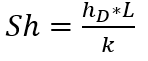
This is a measure of the ratio of convective and diffusive mass transfer in a fluid.  It is analogous to the Nusselt Number in heat transfer and summarized as shown:


Where:


  • hD = Mass Transfer Coefficient (m/s)
  • L = Characteristic length (m)
  • k = Molecular Diffusivity (m2/s)

Froude Number (Fr)

It is a measure of the ratio of the inertial and gravitational forces and can be expressed as:     

Where:


  • v = Velocity (m/s)
  • g = Acceleration due to gravity (m/s2)
  • L = Characteristic length (m)

It is often used to analyze fluid flow problems on a free surface.  For example, in agitated vessels, Fr governs the formation of free surface vortices:

Grashof Number (Gr)

This is a ratio of the buoyancy and viscous forces. It is used to calculate heat transfer in natural convection where the fluid velocity depends on buoyancy.  It can be expressed as:


Where:


  • β = Volumetric coefficient of thermal expansion (1/K)
  • g = Acceleration due to gravity (m/s2)
  • ΔT = Temperature difference (K)
  • L = Characteristic length (m)
  • ρ = Fluid Density (kg/m3)
  • μ = Dynamic Viscosity (Pa.s)


Mach Number (Ma)

This is the ratio of the fluid velocity to the velocity of sound in that medium.  It can be expressed as:

Where:


  • u = Fluid velocity (m/s)
  • a = Speed of sound in fluid medium (m/s)


In Chemical Engineering, the Mach Number is commonly used in calculations that involve high velocity gas flow.


Schmidt Number (Sc)

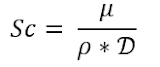
This is the ratio of kinematic viscosity to the diffusivity and it characterizes mass transfer in a flowing fluid. It can be expressed as:

Where:

  • μ = Dynamic viscosity (Pa/s)
  • ρ = Fluid Density (kg/m3)
  • = Diffusivity (m2/s)

Biot Number (Bi)

It is the ratio of the internal thermal resistance of a solid to the boundary layer species transfer resistance. It can also be defined as the ratio of internal conductive resistance to the external convective resistance. It is represented as shown:

Where:

  • h = Convective heat transfer coefficient (W/m2.K)
  • LC = Characteristic Length (m)
  • k = Thermal conductivity (W/m.K)


Bi < 0.1 indicates the applicability of the lumped heat analysis.

Biot Number helps analyze the interaction between conduction in a solid and convection at its surface. Smaller Bi number values signify that conduction is dominating the heat transfer mechanism while larger Bi number values signify that convection is dominating the heat transfer process.

Momentum Equation

From the  previous chapter, we saw that the continuity equation is a conservation of mass equation with which mass transfers across boundar...