Chemical Engineering Tutorials: Separation Techniques
Showing posts with label Separation Techniques. Show all posts

Tuesday, 16 June 2026

Liquid-Liquid Extraction

Liquid-liquid extraction is the separation of the components in a liquid phase (diluent) by treatment with a solvent in which one or more of the desired components are preferentially soluble. Normally, the diluent + remaining solute is called the raffinate phase while the second solvent + the solute is the extract phase.

It is a process that is suitable to separate materials that may decompose at high temperatures.

Below is an example of an extraction process diagram:

This process is commonly used in the separation of hydrocarbons in the petroleum industry like the separation of aromatics from kerosene-based fuels oils (to improve their burning qualities), separation of aromatics from paraffin and naphthenic compounds (to improve the temperature-viscosity characteristics of lubricating oils), to obtain relatively pure compounds (benzene, toluene and xylene) from catalytically produced reformats.

For liquid-liquid extraction, it is vital that the liquid mixture feed and solvent are at-least partially or completely immiscible and three stages are involved:

a) The feed mixture and solvent are made to contact.
b) Separation of the resulting two phases.
c) Removal and recovery of the solvent from each phase.

Stages (a) and (b) can be combined into a single piece of equipment like a column that operates continuously known as differential contacting. Liquid-liquid extraction is also carried out in a stage-wise equipment like a mixer-settler unit. Extraction can either occur through physical operation or a chemical operation. 

Extraction is a preferred alternative to distillation is cases where:

  • Distillation would require excessive amounts of heat like when the relative volatility is near unity.
  • The components in the feed have very close boiling points
  • The components to be separated are very different in nature.
  • The formation of azeotropes limits the degree of separation obtainable.
  • One of the components is present at a concentration that is too low for distillation to occur.
  • Heating must be avoided.

Mass Balance

If we perform an overall mass balance calculation on the above system from stage 1 to stage N, we get:

F + S = E1 + RN

Criteria for Selecting a Solvent for Liquid–Liquid Extraction

  • Selectivity: A solvent's ability to separate components A and C (desired compound) is determined by comparing the concentration ratio of C to A in the solvent-rich phase with that in the A-rich phase at equilibrium. For extraction to be effective, the selectivity must be greater than one; higher values indicate better separation efficiency. If the selectivity equals one, separation cannot be achieved.
  • Recoverability: The chosen solvent should be easy to recover and recycle using methods that are both safe and cost-effective.
  • Density: A significant difference in the densities of the two saturated liquid phases is desirable, as it facilitates phase separation.
  • Interfacial Tension: High interfacial tension is generally preferred because it promotes the coalescence of emulsified droplets. However, it can also make the dispersion of one liquid into another more difficult.
  • Safety & Cost: An ideal solvent should be non-toxic, non-flammable, and economical to use.
  • Chemical Stability: The solvent should be chemically stable and non-reactive toward the components being separated as well as the materials used in the equipment.
  • Viscosity, Vapor Pressure & Freezing Point: Low viscosity, low vapor pressure, and a low freezing point are advantageous because they simplify handling, storage, and processing operations.

Uses of Liquid-liquid Extraction

  • Extraction of valuable products from a fermentation broth.
  • Purification of heat sensitive materials like pharmaceuticals, fragrances etc.
  • Removal of high boiling organics like phenol, aniline etc., from waste water.
  • Recovery of reaction products. 

Limitations of Liquid-liquid Extraction

  • Time consuming and laborious.
  • Consumes a large amount of organic solvents hence environmentally polluting. 
  • Generates a large amount of waste.
  • Selectivity is low.
  • Can result in the formation of hard to break emulsions.

Differences Between Liquid-liquid Extractions and Distillation.

  • Liquid-liquid extraction uses differences in solubilities of solutes in two solvents while distillation uses differences of boiling points of components in a mixture
  • Liquid-liquid extraction uses selective solubility as a degree of separation while distillation uses relative volatility as a degree of separation
  • Liquid-liquid extraction doesn’t produce pure products while distillation produces almost pure products
  • Liquid-liquid extraction uses a separating funnel while a distillation apparatus is used for distillation
  • No new phases created during liquid-liquid extraction while new phases are created by addition of heat during distillation
  • Liquid-liquid extraction doesn’t require heating and cooling provisions while distillation does


Monday, 3 June 2024

Introduction to Mass Transfer II

 As previously defined (Click hereMass transfer is the movement of components under a chemical potential gradient from an area of high concentration to that of a lower concentration. Once the gradient equals zero then equilibrium is established.

Mass transfer depends on the diffusion of molecules from one distinct phase to another. It is based on the differences in physical and/or chemical properties of the molecules in motion. These properties include solubility and vapor pressure. For interphase mass transfer, a concentration gradient exists between the bulk and interface. Under steady state conditions an interface equilibrium is assumed. An interface is the boundary between different phases.

Many industrial processes depend on mass transfer which aids in the movement of materials from one homogeneous phase to another. These include:

Adsorption and desorption – This process uses the ability of molecules to move from either gas or liquid phase to the surface of solid particles. Adsorption does not qualify as a true inter phase mass transfer operation as the fluid adheres to the solid surface instead of dissolving in the solid. Desorption is the opposite of adsorption as mass transfer occurs from the solid surface (adsorbent) to the liquid or gas phase (adsorbates).

This process is applied in:

  • Removing toxic gases and smells from the air.
  • Solvent recovery
  • Removing ions from solutions

Adsorption is also discussed here.


Absorption and stripping – Absorption is the transfer of materials from a gas to a liquid phase. The gas is absorbed by a liquid in which the solute gas is more or less soluble from its mixture with an inert gas, as well as more or less insoluble gas. The liquid is immiscible in the gas phase. An example of absorption is the separation of ammonia from an air-ammonia mixture using water with the solute recovered from the solution using distillation. Absorption is also discussed here.

Stripping is the separation of a gas solute from a liquid phase.


Distillation – This is a process where a miscible, volatile liquid mixture is separated into its individual components using partial vaporization. The components vaporize when their boiling points are reached then are condensed into their liquid states. This is widely used in the purification of crude oil into gasoline, kerosene, fuel oil and lubricating oil.

In industrial applications, distillation commonly occurs in a distillation column. Some majore aspects of a distillation column are discussed here.


Extraction – This is a process where the separation of the constituents of a liquid solution is achieved by contact with another insoluble liquid. The liquid used to achieve this process is called a solvent while the solution to be extracted is called a feed. The product which is solvent rich is referred to as the extract while the residual liquid from which the solute is removed is called the raffinate.

Real world applications include the separation of aromatics from kerosene-based fuel oils, the production of fuels in the nuclear industry and the separation of penicillin from fermentation mixtures.


Leaching – This is the treatment of finely divided solids with a liquid.

Examples include oilseed extraction, extraction of sugar beets with hot water and extraction of medicinal compounds from plant roots, leaves and stems.


Humidification and dehumidification – Humidification refers to the increase of the vapor content of a gas stream by passing it over a liquid. Dehumidification on the other hand, involves the transfer of water vapor from the gas phase to the liquid phase. 


Membrane separation – This process involves the diffusion of a solute from one fluid stream through a semi-permeable membrane into another fluid stream. The components are selectively separated from the original solution from one side of the membrane to the other.

A membrane can be defined as a heterogeneous phase acting as a barrier to the flow of molecules and ionic species in liquid or vapor phases. If one component of the mixture travels faster in the membrane, a separation can be achieved. Based on their nature, heterogeneous barrier membranes can be classified into solid and liquid membranes.

Reverse osmosis and electrodialysis are examples of process that use membrane separation.


Crystallization – This is a process where a solid is formed from a liquid solution based on the difference in the solute concentration and its solubility at a certain temperature. In this process the solute transfer occurs from the liquid solution to a pure solid crystalline phase. When the concentration of the solute becomes higher than its solubility at a certain temperature, then the solute comes out of the solution is the form of a crystal.

Salt is extracted from sea water using crystallization.


Drying and Evaporation – Drying is the process of removing a small amount of water or other liquids from a solid material. The water is removed at a temperature below the boiling point of water by circulating air or another carrier gas over the material.  Evaporation is the removal of a large amount of water from solutions. The water is removed as a vapor at its boiling point.


In summary:

Separation Process

Separating Agent

Typical Applications

Adsorption

Adsorbent Solid

Separation of organics from gas.

Gas Absorption & Stripping

Solvent

Removal of CO2 from synthesis gas and CO2 and H2S from natural gas.

Distillation

Heat

Fractionation of crude oil.

Liquid-liquid Extraction

Solvent

Removal of aromatics from gasoline.

Solid-liquid Extraction

Solvent

Extraction of caffein from

coffee.

Membrane separation

Membrane

Desalination of water.

Crystallization

Removal of heat

Production of salts and sugar.

Drying

Heat/Drying gas

Drying of fruits and polymer beads.


Monday, 23 October 2023

Definitions of Words and Phrases Used in Separation Equipment

Coalescing: The process or mechanism of merging small droplets or aerosols and creating larger droplets that can easily be removed by gravity. It also refers to the joining of liquid droplets dispersed in another immiscible liquid e.g. water drops in oil.

Gas coalescing filter: A separator containing changeable elements that is capable of the removal of sub-micron aerosols and solids. This coalescing and filtering occurs as the gas flows from the inside of the filter/coalescing element to the outside of this element in the vertical filter-coalescer. Properly designed, this coalescing stage will remove solids and fine aerosols down to 0.3 micron and larger. 

Electrostatic coalescer: A device used to remove dispersed water from oil by using a high voltage field to polarize and/or charge dispersed water droplets.

Emulsion: A stable dispersion of one immiscible liquid in another liquid. 

Entrainment: Fluid in the form of a mist, fog, droplets or bubbles carried along with the continuous phase.

Filter: A device used to separate solids from liquid or gas flow. Most filters utilize removable elements. 

Filter separators: A device to remove solids and entrained liquids from a gas stream. It usually has two compartments. The first compartment contains filter coalescing elements. As the gas flows through the elements, the liquid particles coalesce into larger droplets and when the droplets reach sufficient size, the gas flow causes them to flow out of the filter elements into the center core. The particles are then carried into the second compartment of the vessel where the larger droplets are removed. A lower barrel or boot may be used for surge or storage of the removed liquid.

Flash drum: A vessel used to separate liquids, generated due to pressure reduction and/or increase in temperature of a liquid stream, from the gas phase or two phase fluid. 

Gas-oil ratio (GOR): The ratio of gas to hydrocarbon at a defined condition, typically expressed as Sm3/m3

Heater-treater: A device used to process hydrocarbon, by warming and coalescence, in order to remove small quantities of residual water so as to meet transportation or product specifications. 

Line drop: A boot or underground vessel, used on a pipeline, to provide a place for free liquids to separate and accumulate. It is used in pipelines with very high gas-to-liquid ratios to remove only free liquid from a gas stream. It will remove bulk liquid, but not necessarily all the liquid. 

Knock out drum: Generic term used to describe vessels for gas-liquid separation. Separation can be either for high, or low, gas-to-liquid ratio streams.

Liquid coalescer: A vessel internal used for increasing the droplet size of immiscible liquids, so that they can be removed by gravity separation. Typical coalescing elements are stacked plates, vanes, wire or plastic mesh, or cartridge type elements. 

Liquid-liquid separators: A vessel where two liquid phases are separated. 

Mist eliminator: A fixed device used to enhance removal of smaller liquid droplets from a gas above which is not normally possible by gravity separation. Typical mist eliminator designs include knitted wire mesh, vane type, and cyclonic.

Production separator: A vessel typically used as the first separation device that the fluid encounters in the wellhead to processing plant production network (sometimes is called Wellhead Separator, when physically located at the well site). 

Retention time: For gas-liquid separation, the average time a flowing fluid remains within the liquid section of a separator at the design feed rate. For three phase separation, the retention time can be the time the total fluid remains in the separation section at the design feed rate, or if defined as phase retention time, the time the phase remains in the separation section. 

Scrubber: A category of separator used for high gas-to-liquid ratios. Scrubbers are used as the primary separator in systems where small amounts of liquid are produced, to ‘polish’ an already-separated gas stream by removing residual contaminants more completely, or as a backup in case of an operational upset upstream.

Separator: A generic term for a device which separates gas-liquid, gas-liquid-liquid, gas–solids, liquid-solids or gas-liquid- solids. 

Slug catcher: A particular separator design which is able to absorb sustained in-flow of large liquid volumes at irregular intervals. Usually found on gas gathering systems or other two-phase pipeline systems at the terminus of the pipeline. A slug catcher may be a single large vessel or a manifolded system of pipes. 

Surge drum: A vessel used to provide appropriate time for flow control and dampening during process variations and upsets. The capacity of the surge drum provides the ability to accept liquids from the upstream process, or provide liquids to down stream equipment without upsets. 

Surge time: The time it takes to fill a specified fraction of a vessel, defined as the volume between a specified level range in a vessel divided by the design feed flow rate. 

Test separator: A separator vessel used near the wellhead, which separates the phases for well test metering. 

Three phase separator: A vessel used to separate gas and two liquids of different densities (e.g. gas, water, and oil) into three distinct streams.

Tuesday, 17 October 2023

Distillation column: How to fix temperature and pressure

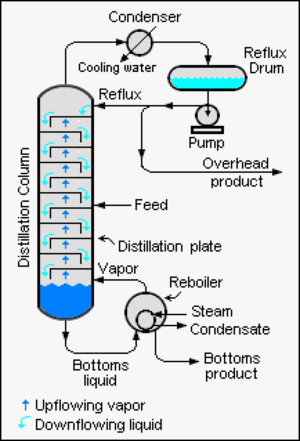
A distillation column can be illustrated as follows:


Pressure Profile

In a distillation column there exists a pressure gradient. The pressure at the bottom is higher and lowers towards the top of the column. This pressure gradient occurs due to the trickling liquid that restricts the upward flow of vapour thus creating a pressure loss on the flow. 

In steady-state distillation processes, the column pressure is kept constant and the temperature is varied to control the composition of the product streams.
In normal situations, the vapor pressure of the liquid on the top tray fixes the pressure at that location before the vapor enters the overhead condenser. This parameter fixes the column pressure. The pressure in the other sites in the column depends on the ability of the vapors and liquids to distribute themselves up and down the column with minimum pressure drops. 

It is the liquid composition on the top tray that defines the expected column operating pressure. 
The external reflux ratio (L/D) has a bearing on fixing that composition – as the various L/V’s (internal reflux ratios) that are generated down the column have on the various trays’ compositions. 

The bottom pressure will be determined by the pressure drop along the column. This depends on the relevant selected technology and the load of vapor and liquid inside the column. The corresponding bubble point of bottom pressure will specify the bottom temperature. 

The purpose of the reflux is to provide down-flowing liquid throughout the rectification section to contact with the up-flowing vapor in order to achieve stage-by-stage equilibrium heat and mass transfer thus purifying the top product. When sub-cooled reflux is introduced to the top tray, it must be heated up to its bubble point before the lighter components will vaporize.


Temperature Profile

The temperature distribution in a distillation column is warmer at the bottom and cooler at the top. For a binary feed mixture, the temperature at the bottom is just lower than the boiling point of the heavier component while the temperature at the top is just above the boiling point of the lighter component. 

At the bottom of the column, it is desired that the heavy component remains as a liquid and the lighter component remains as a gas, thus the temperature at the bottom should match this requirement. The temperature of the bottom is controlled by a reboiler. The heat added at the bottom is easy to control through steam or hot oil flow rates. 

It is the opposite at the top of the column, i.e., the light component is required to remain a gas while the heavier component is condensed and trickles down the column. The temperature at the top is set above the boiling point of the lighter component. The top product is usually needed in liquid form for easy storage hence the gaseous products need to be condensed. This liquid stream is then split into two where one stream is returned to the column and the other is sent to storage. 

The temperature at the top is controlled by adjusting the reflux rate. The Reflux Rate is the flow rate of the liquid sent back to the top of the column. A higher reflux rate results in more cooler liquid falling down the column against the rising warmer gas, and the top temperature is lower.

Overall heat is added at the bottom of the column awhile heat is extracted at the top of the column. Inside the column the temperature balance is created between the hot gas rising up the column and the cooler liquid falling down the column.

Inside the column, the temperature is set by the relative volatility or the partial pressure of the feed according to Raoult’s law. The volatility of components in the column is different. If P is the total pressure in the column, this is equal to the sum of P1 + P2 + P3 + ---- partial pressures at a different height. 

While total pressure is constant in the column, the partial pressures of the feed components are different along with the height. 

Partial pressure = Mole fraction x Vapor pressure of pure component at a height 


Since volatility of hydrocarbon increases as you go up, the vapor pressure increases, and consequently, saturation temperature gets lower. Therefore, the column gets cooler as we go up. In a steady-state, the partial pressures do not change much.


Remember

Raoult's law states that the vapor pressure of a solvent above a solution is equal to the vapor pressure of the pure solvent at the same temperature scaled by the mole fraction of the solvent present

What is L/D?

It is the external reflux ratio: It is the ratio of the liquid returned to the column divided by the liquid removed as product, i.e., R = L/D.  

As the external reflux cools the top of the tower, vapors consisting of heavier fraction condense and flow down the tower and it's referred to as internal reflux. The liquid/vapor flow ratio inside the upper section of the column.is referred to as the internal reflux ratio i.e., L/V.


THE CONTINUITY EQUATION

The continuity equation is a statement of conservation of mass (covered in  this   blog entry as Equation 4.) The flow quantity N becomes m,...