Let us determine the pressure at any point in a fluid a rest. For this, let us consider a wedge-shaped particle that is exposed on all sides to a fluid. This is presented as follows:

The cross section of the particle can be used to
sketch a free-body diagram, as shown below:

The dimensions Δx, Δy, and Δz are small and approach
zero as the particle shrinks to a point. Pressure and gravity are the only
forces considered to be acting on the particle. Applying Newton’s second law in
the x- and z-directions respectively, we obtain the following equations;

where:
- px, pz, and ps are average pressures acting on the three corresponding faces
- ax and az are the accelerations
- ρ is the particle density
The net force equals zero in a static fluid. After
simplification, with ax = az = 0, these two equations
become:
pxΔz
– psΔs(sinθ) = 0 and
pzΔx
– psΔs(cosθ) – (ρg/2)ΔxΔz = 0
(ρg/2)ΔxΔz can be
neglected as it is a higher-order term containing ΔxΔz, which is very small in
comparison to the other terms. From the geometry of the wedge, we find that:
Δz = Δs sinθ and Δx = Δs cosθ
Since θ is chosen arbitrarily
chosen, substitution into the pressure equations we obtain:

This shows that pressure
at a point is the same in all directions and is applicable to both 2 dimension
and 3-dimension cases.
Let us consider an
element of a fluid at rest, as illustrated below:

The element chosen has a
volume, dx dy dz, and is sketched on a coordinate system where the positive
z-direction is downward, coincident with the direction of the gravity force.
The following figure is a view of the element looking in the positive y-direction; the force acting on the right face is pdydz and that on the left face is (p + (∂p/∂x)dx)dydz, both normal to their respective surfaces.

Summing forces in the
x-direction, we have the following for a static fluid:

this means that pressure does not vary with respect to
x. Similarly, for the y-direction we can assume the same as x-direction, hence:
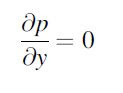
These two equations show that there is no pressure variation in any lateral direction.
If we create a free body diagram for the z-direction and add up the forces, we obtain:


This shows that pressure does vary in a static fluid
in the z-direction i.e., pressure increases with depth. This is mathematical
shown by integrating both sides of the above equation:

where point 1 is a reference point such as the free
surface of a liquid and point 2 is a point of interest. Since the density is a
constant for incompressible fluids, we get:
p2 – p1 = ρg(z2 – z1)
= ρgΔz
where Δz is the depth below the liquid surface. This
relationship is the basic equation of hydrostatics and is often written as:
Δp = ρgz


No comments:
Post a Comment