Chemical Engineering Tutorials

Monday, 23 October 2023

Definitions of Words and Phrases Used in Separation Equipment

Coalescing: The process or mechanism of merging small droplets or aerosols and creating larger droplets that can easily be removed by gravity. It also refers to the joining of liquid droplets dispersed in another immiscible liquid e.g. water drops in oil.

Gas coalescing filter: A separator containing changeable elements that is capable of the removal of sub-micron aerosols and solids. This coalescing and filtering occurs as the gas flows from the inside of the filter/coalescing element to the outside of this element in the vertical filter-coalescer. Properly designed, this coalescing stage will remove solids and fine aerosols down to 0.3 micron and larger. 

Electrostatic coalescer: A device used to remove dispersed water from oil by using a high voltage field to polarize and/or charge dispersed water droplets.

Emulsion: A stable dispersion of one immiscible liquid in another liquid. 

Entrainment: Fluid in the form of a mist, fog, droplets or bubbles carried along with the continuous phase.

Filter: A device used to separate solids from liquid or gas flow. Most filters utilize removable elements. 

Filter separators: A device to remove solids and entrained liquids from a gas stream. It usually has two compartments. The first compartment contains filter coalescing elements. As the gas flows through the elements, the liquid particles coalesce into larger droplets and when the droplets reach sufficient size, the gas flow causes them to flow out of the filter elements into the center core. The particles are then carried into the second compartment of the vessel where the larger droplets are removed. A lower barrel or boot may be used for surge or storage of the removed liquid.

Flash drum: A vessel used to separate liquids, generated due to pressure reduction and/or increase in temperature of a liquid stream, from the gas phase or two phase fluid. 

Gas-oil ratio (GOR): The ratio of gas to hydrocarbon at a defined condition, typically expressed as Sm3/m3. 

Heater-treater: A device used to process hydrocarbon, by warming and coalescence, in order to remove small quantities of residual water so as to meet transportation or product specifications. 

Line drop: A boot or underground vessel, used on a pipeline, to provide a place for free liquids to separate and accumulate. It is used in pipelines with very high gas-to-liquid ratios to remove only free liquid from a gas stream. It will remove bulk liquid, but not necessarily all the liquid. 

Knock out drum: Generic term used to describe vessels for gas-liquid separation. Separation can be either for high, or low, gas-to-liquid ratio streams.

Liquid coalescer: A vessel internal used for increasing the droplet size of immiscible liquids, so that they can be removed by gravity separation. Typical coalescing elements are stacked plates, vanes, wire or plastic mesh, or cartridge type elements. 

Liquid-liquid separators: A vessel where two liquid phases are separated. 

Mist eliminator: A fixed device used to enhance removal of smaller liquid droplets from a gas above which is not normally possible by gravity separation. Typical mist eliminator designs include knitted wire mesh, vane type, and cyclonic.

Production separator: A vessel typically used as the first separation device that the fluid encounters in the wellhead to processing plant production network (sometimes is called Wellhead Separator, when physically located at the well site). 

Retention time: For gas-liquid separation, the average time a flowing fluid remains within the liquid section of a separator at the design feed rate. For three phase separation, the retention time can be the time the total fluid remains in the separation section at the design feed rate, or if defined as phase retention time, the time the phase remains in the separation section. 

Scrubber: A category of separator used for high gas-to-liquid ratios. Scrubbers are used as the primary separator in systems where small amounts of liquid are produced, to ‘polish’ an already-separated gas stream by removing residual contaminants more completely, or as a backup in case of an operational upset upstream.

Separator: A generic term for a device which separates gas-liquid, gas-liquid-liquid, gas–solids, liquid-solids or gas-liquid- solids. 

Slug catcher: A particular separator design which is able to absorb sustained in-flow of large liquid volumes at irregular intervals. Usually found on gas gathering systems or other two-phase pipeline systems at the terminus of the pipeline. A slug catcher may be a single large vessel or a manifolded system of pipes. 

Surge drum: A vessel used to provide appropriate time for flow control and dampening during process variations and upsets. The capacity of the surge drum provides the ability to accept liquids from the upstream process, or provide liquids to down stream equipment without upsets. 

Surge time: The time it takes to fill a specified fraction of a vessel, defined as the volume between a specified level range in a vessel divided by the design feed flow rate. 

Test separator: A separator vessel used near the wellhead, which separates the phases for well test metering. 

Three phase separator: A vessel used to separate gas and two liquids of different densities (e.g. gas, water, and oil) into three distinct streams.

Tuesday, 17 October 2023

Distillation column: How to fix temperature and pressure

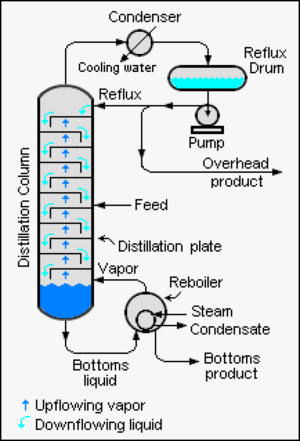
A distillation column can be illustrated as follows:


Pressure Profile

In a distillation column there exists a pressure gradient. The pressure at the bottom is higher and lowers towards the top of the column. This pressure gradient occurs due to the trickling liquid that restricts the upward flow of vapour thus creating a pressure loss on the flow. 

In steady-state distillation processes, the column pressure is kept constant and the temperature is varied to control the composition of the product streams.
In normal situations, the vapor pressure of the liquid on the top tray fixes the pressure at that location before the vapor enters the overhead condenser. This parameter fixes the column pressure. The pressure in the other sites in the column depends on the ability of the vapors and liquids to distribute themselves up and down the column with minimum pressure drops. 

It is the liquid composition on the top tray that defines the expected column operating pressure. 
The external reflux ratio (L/D) has a bearing on fixing that composition – as the various L/V’s (internal reflux ratios) that are generated down the column have on the various trays’ compositions. 

The bottom pressure will be determined by the pressure drop along the column. This depends on the relevant selected technology and the load of vapor and liquid inside the column. The corresponding bubble point of bottom pressure will specify the bottom temperature. 

The purpose of the reflux is to provide down-flowing liquid throughout the rectification section to contact with the up-flowing vapor in order to achieve stage-by-stage equilibrium heat and mass transfer thus purifying the top product. When sub-cooled reflux is introduced to the top tray, it must be heated up to its bubble point before the lighter components will vaporize.


Temperature Profile

The temperature distribution in a distillation column is warmer at the bottom and cooler at the top. For a binary feed mixture, the temperature at the bottom is just lower than the boiling point of the heavier component while the temperature at the top is just above the boiling point of the lighter component. 

At the bottom of the column, it is desired that the heavy component remains as a liquid and the lighter component remains as a gas, thus the temperature at the bottom should match this requirement. The temperature of the bottom is controlled by a reboiler. The heat added at the bottom is easy to control through steam or hot oil flow rates. 

It is the opposite at the top of the column, i.e., the light component is required to remain a gas while the heavier component is condensed and trickles down the column. The temperature at the top is set above the boiling point of the lighter component. The top product is usually needed in liquid form for easy storage hence the gaseous products need to be condensed. This liquid stream is then split into two where one stream is returned to the column and the other is sent to storage. 

The temperature at the top is controlled by adjusting the reflux rate. The Reflux Rate is the flow rate of the liquid sent back to the top of the column. A higher reflux rate results in more cooler liquid falling down the column against the rising warmer gas, and the top temperature is lower.

Overall heat is added at the bottom of the column awhile heat is extracted at the top of the column. Inside the column the temperature balance is created between the hot gas rising up the column and the cooler liquid falling down the column.

Inside the column, the temperature is set by the relative volatility or the partial pressure of the feed according to Raoult’s law. The volatility of components in the column is different. If P is the total pressure in the column, this is equal to the sum of P1 + P2 + P3 + ---- partial pressures at a different height. 

While total pressure is constant in the column, the partial pressures of the feed components are different along with the height. 

Partial pressure = Mole fraction x Vapor pressure of pure component at a height 


Since volatility of hydrocarbon increases as you go up, the vapor pressure increases, and consequently, saturation temperature gets lower. Therefore, the column gets cooler as we go up. In a steady-state, the partial pressures do not change much.


Remember: 

Raoult's law states that the vapor pressure of a solvent above a solution is equal to the vapor pressure of the pure solvent at the same temperature scaled by the mole fraction of the solvent present

What is L/D?

It is the external reflux ratio: It is the ratio of the liquid returned to the column divided by the liquid removed as product, i.e., R = L/D.  

As the external reflux cools the top of the tower, vapors consisting of heavier fraction condense and flow down the tower and it's referred to as internal reflux. The liquid/vapor flow ratio inside the upper section of the column.is referred to as the internal reflux ratio i.e., L/V.


Saturday, 7 October 2023

Introduction to Fluid Mechanics

Mechanics studies the motion and deformation of material bodies under applied loads like forces and moments.

It involves loads, energy, motion, deformation and material properties. 

When the material is either in the liquid or gas phase it is called fluid mechanics. With fluid referring to both liquids and gases. 

The most basic differences between solids, liquids and gases are presented below:


Mechanics deals with both stationary and moving bodies under the influence of loads. 

  • Statics  deals with bodies at rest. 
  • Dynamics deals with bodies in motion.
Fluid mechanics deals with how fluids at rest (fluid statics) and in motion (fluid dynamics) behave.
  • Gas dynamics studies compressible flow of gases with high density changes. 
  • Aerodynamics is similar to gas dynamics, but also covers low speed flows. It focuses on air flow.
  • Hydrodynamics studies liquids (incompressible flow) in motion. 


The Concept of Continuum

At the microscopic level fluids consist of molecules. However, in engineering we deal with the fluid on a macroscopic level and ignore the behavior of each individual molecule i.e. we treat the fluid as a whole, a continuum.

In Continuum it is assumed that the fluid and flow properties like density, velocity, pressure, temperature, etc. vary continuously throughout the fluid. 
In continuum, the smallest element of a fluid is NOT a fluid molecule, but rather a fluid particle, which contains enough number of molecules to make meaningful statistical averages.
The Knudsen Number can determine whether the Continuum Assumption is valid for any case.


Continuum is valid when Kn < 0.01


Dimensions and Units

In the MLT system, the basic dimensions are: Mass [M], Length [L], Time [T]. All other quantities are expressed in terms of these three.
For some problems, Temperature [𝜃] also serves as a basic dimension.
Equations should be dimensionally homogeneous, i.e. dimensions of the left and right sides should be the same.

Fundamental Flow and Fluid Properties


It is common to use pressure (p) and temperature (T) to fix the thermodynamic state. Then other properties can be expressed as a function of these two:

                                       𝜌=𝜌(𝑝,𝑇),       ℎ=ℎ(𝑝,𝑇),       𝜇=𝜇(𝑝,𝑇)


Wednesday, 13 September 2023

Unlocking the Wonders of Silica Aerogel: Features, Applications, and Future Horizons

Silica aerogel, often referred to as "frozen smoke" or "blue smoke," is a captivating material that has captured the imagination of scientists and engineers alike. This ultra-lightweight substance boasts remarkable features, making it a standout in the world of chemical engineering. In this blog post, we will explore the most important aspects of silica aerogel, from its exceptional properties to its wide-ranging applications and future prospects.

Features of Silica Aerogel

Exceptional Porosity

Silica aerogel holds the distinction of being one of the lightest and most porous materials known to humanity. Its structure is comprised of tiny interconnected silica nanoparticles, resulting in an incredibly high surface area. Imagine a sponge, but one so porous that it appears almost weightless. This unique feature makes silica aerogel a champion in applications requiring large surface areas and minimal density.

Superb Thermal Insulation

When it comes to thermal insulation, silica aerogel reigns supreme. Its low thermal conductivity, combined with its lightness, makes it an ideal choice for extreme temperature environments. In fact, NASA has utilized silica aerogel in space missions to insulate spacecraft and protect instruments from the harsh conditions of outer space. This material's insulating prowess extends to terrestrial applications as well, such as improving the energy efficiency of buildings.

Exceptional Transparency

Silica aerogel's transparency is another captivating aspect. It allows light to pass through while maintaining its impressive insulating properties. This unique combination of features makes it a candidate for applications in optics and windows. Imagine having windows that not only insulate your home but also provide abundant natural light.

Applications of Silica Aerogel

Oil Spill Cleanup

One of the most notable applications of silica aerogel is in environmental remediation, particularly for oil spills. Silica aerogels can selectively absorb hydrophobic substances, such as oil, while repelling water. This property makes them highly efficient at cleaning up oil spills, mitigating environmental damage, and reducing the impact on aquatic ecosystems.

Construction and Energy Efficiency

In the realm of construction, silica aerogel is a game-changer. It can be incorporated into building materials to enhance their thermal insulation properties. Transparent aerogels are also being explored as window insulation materials, promising significant energy savings in buildings by reducing heating and cooling costs.

Space Exploration

Silica aerogels have played a pivotal role in space exploration. NASA has used them to capture cosmic dust particles during missions. Their exceptional thermal insulation properties have protected sensitive equipment in spacecraft, allowing them to endure the rigors of space travel. This makes silica aerogel an unsung hero of interstellar exploration.

Future Prospects

As we look to the future, silica aerogel holds immense promise in various domains:

Nanotechnology and Electronics

The nanotechnology and electronics industries are set to benefit from silica aerogel's unique properties. Its high surface area and porosity make it an excellent candidate for nanoscale applications, such as catalysis and energy storage. In electronics, silica aerogels could find use in advanced batteries and supercapacitors.

Medical and Biotechnology

Silica aerogels are finding their way into the medical and biotechnology sectors. Their biocompatibility and porous nature make them suitable for drug delivery, tissue engineering, and diagnostics. Researchers are exploring innovative ways to harness these properties for medical advancements.

Environmental Remediation

Beyond oil spill cleanup, silica aerogels have potential applications in addressing other environmental challenges. They could be used to remove pollutants from water sources or capture greenhouse gases, contributing to a cleaner and more sustainable future.

In conclusion, silica aerogel is a material that has captivated the world of chemical engineering with its extraordinary features, diverse applications, and exciting future prospects. As scientists and engineers continue to unlock its potential, we can expect to see silica aerogel making a significant impact across various industries, from space exploration to environmental conservation. The future looks promising, and silica aerogel is at the forefront of innovation.

Selected Further Reading

  • Shi, H., Cui, J., Shen, H., & Wu, H. (2014). Preparation of Silica Aerogel and Its Adsorption Performance to Organic Molecule. Advances in Materials Science and Engineering, Volume 2014, 1–8.
  • Sivri, S., Dilek, C., & Sezgi, N. A. (2019). Synthesis and Characterization of Aluminum Containing Silica Aerogel Catalysts for Degradation of PLA. International Journal of Chemical Reactor Engineering, 20180163, 1–10.
  • Tamon, H., Kitamura, T., & Okazaki, M. (1998). Preparation of Silica Aerogel from TEOS, Journal of Colloid and Interference Science. 359(197), 353–359.
  • Wang, L. J., Zhao, S. Y., & Yang, M. (2008). Structural characteristics and thermal conductivity of ambient pressure dried silica aerogels with one-step solvent exchange/surface modification. Materials Chemistry and Physics, 113(1), 485–490.
  • Schüth, Ferdi & Schmidt, W. (2002). Microporous and Mesoporous Materials. Advanced Engineering Materials, 4, No.5, 269–279
  • Pajonk, G. M. (2003). Some applications of silica aerogels. Colloid and Polymer Science, 281(7), 637–651.

Wednesday, 6 September 2023

Hydrogen Production: Natural Gas Reforming

This is a vital technology pathway for hydrogen production. Methane (CH4) that is contained in natural gas can be used to produce hydrogen through thermal processes like steam-methane reformation and partial oxidation.

a)     Steam-Methane Reforming

This is the most common and cost-effective method for hydrogen production, and it contributes to about 50% of the world's hydrogen production.

In this production process, high-temperature steam (700°C–1,000°C) is used to produce hydrogen from a methane source like natural gas. In this process methane reacts with steam under 3–25 bar pressure (1 bar = 14.5 psi) in the presence of a catalyst. This results in the production of hydrogen, carbon monoxide, and a small amount of carbon dioxide. Heat is supplied to the steam reforming process hence it is endothermic. Nickel is a common catalyst used in this process. The catalyst being considered must have a high surface area to volume ratio as there may be diffusion limitations at high temperatures. The catalyst shape is also important in order to have a low pressure drop, such shapes may be rings with holes and gear wheels.

In the second step, the carbon monoxide and steam react in the presence of a catalyst to produce carbon dioxide and more hydrogen. This is a process called water-gas shift reaction. These two processes are represented in the following equations:


In the final step, carbon dioxide and other impurities are removed from the gas stream to leave a pure hydrogen stream. This process is called pressure-swing adsorption. Other fuels like ethanol, propane and gasoline can also undergo steam reforming to produce hydrogen.

Although Steam-methane reforming is a mature technology, it suffers from noteworthy disadvantages such as mass and heat transfer issues and coke deposition during the reaction

a)      Partial Oxidation

In this process methane and other hydrocarbons in natural gas react with an oxygen amount that is less to the stoichiometric amount of oxygen needed, thus it doesn’t completely oxidize into carbon dioxide and water. The limited amount of oxygen for oxidation produces mainly carbon monoxide, hydrogen ad small amounts of nitrogen, carbon dioxide and other compounds.

Then, water-gas shift reaction is carried out to form carbon dioxide and more hydrogen.

In this process, heat is given off hence it’s an exothermic process.

This process is faster than steam reforming and requires a smaller reactor. However, this process initially produces less hydrogen per unit of fed fuel than steam reforming of the same amount of fed fuel. 


Energy Equation in Flow Systems

When energy crosses the boundary of a system, the energy in the system changes by an equal amount. Thus a decrease in the energy of a system...