


A condensation reaction is a type of a reaction where two molecules combine to form a single molecule, often water, is then removed from the reaction. For example, when two amino acid molecules combine in a condensation reaction, a covalent bond forms between the amine nitrogen of the first amino acid and the carboxyl carbon of the second amino acid. This results in a molecule of water being removed as a product. This is illustrated below:


These are extremely important substances or materials used in numerous chemical processes.
Catalysts are substances that increase the reaction rate without it itself being consumed in the process. Thus, catalysts do not appear in the overall stoichiometric reaction it is used it but appears in the elementary reactions in the mechanism for the catalyzed reaction.
Examples of catalysts:
This is a process where a catalyst that is in the same phase from the reactants. Typically, everything will be present as a gas or contained in a single liquid phase.
This is process where a catalyst that is in a separate phase from the reactants. Typical examples involve a solid catalyst with the reactants as either liquids or gases.
Most examples of heterogeneous catalysis go through the same stages:
Catalyst lower the activation energy for a reaction. Activation energy is defined as the minimum amount of energy that is needed to a chemical reaction to occur. This is illustrated in the graph below.

Thermal conductivity is very similar to specific heat as both are resistances to heat transfer, however they are not the same. While thermal conductivity gives the rate of heat exchanged in a process, the specific heat gives the quantity of heat exchanged in a process. The inverse of thermal conductivity is thermal resistance.
Thermal conductivity is generally expressed as a scalar quantity and its most general form is a second-rank tensor. Since thermal conductivity is a function of the motion of free electrons it is an intensive property since its a property of a material.
Thermal conductivity is affected by temperature and phase change.
Thermal conductivity is used in calculations for heat conduction using Fourier's Law (click here for Fourier law summary). Fourier's law states that the heat transfer rate through as material is proportional to the negative gradient of temperature change to the length which is perpendicular to that gradient, through which the heat flows.
Steady-state conduction is the form of conduction that occurs when the temperature difference driving the conduction is constant.
Thermal conduction is the transfer of internal energy by microscopic collisions (kinetic energy) of particles (molecules, atoms and electrons) and the movement of electrons within a body. Conduction occurs in all phases: solid, liquid, and gas.
Thermal conduction of gases: Heat transfer occurs through collisions of gas molecules. In the absence of convection, thermal conduction through a gas phase greatly depends on the composition and pressure of this phase, and the mean free path of gas molecules relative to the size of the gas gap.
Thermal conduction of liquids: For liquids, the details of the thermal conduction mechanisms are not properly understood.
Many times, the state of a system does not fall exactly at a value reported in Steam Tables. This is when interpolation is required between the two adjacent properties on a given table. Let us assume that the properties φ1 and φ2 are given at temperatures T1 and T2, respectively. To determine the value of φ at any temperature between T1 and T2, we assume a linear variation of φ with respect to temperature between T1 and T2 as shown in the graph below:

By integrating the slope
of the interpolation line we can develop an expression for our interpolation as
shown below:

Example:
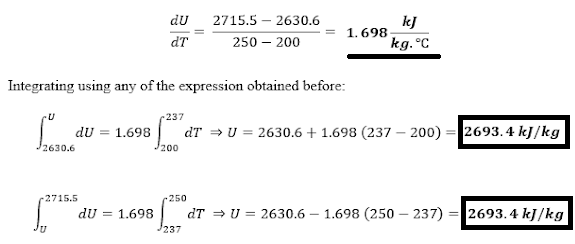
Calculate the Internal Heat Energy (U) of a substance at 237°C and 800 kPa.
Given that for this substance at 800 kPa at 200°C, U = 2630.6 kJ/kg and at
250°C, U = 2715.5 kJ/kg.
Assuming a linear
variation of U from 200 to 250°C, the change in U with respect to temperature
is:
From the previous chapter, we saw that the continuity equation is a conservation of mass equation with which mass transfers across boundar...


