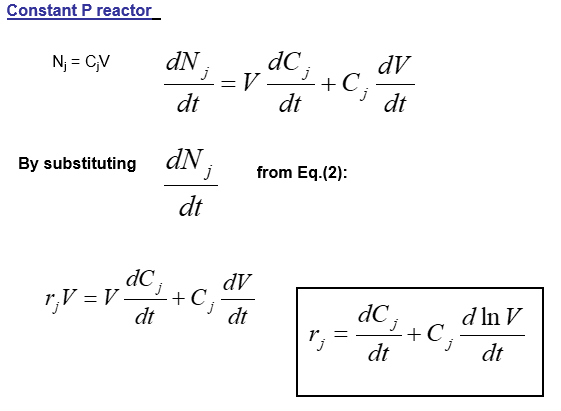
The mathematical relations for batch reactors are discussed below:
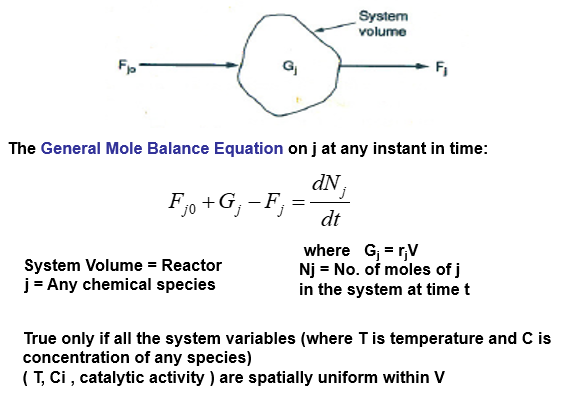
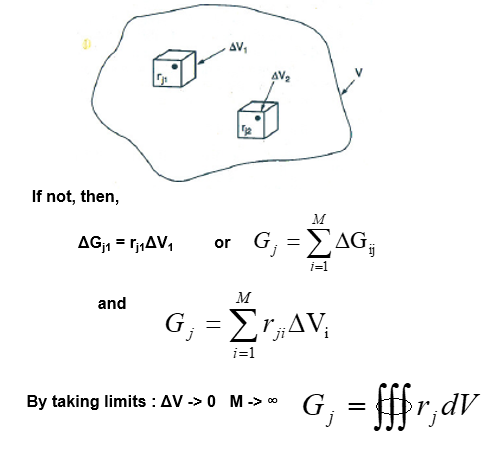
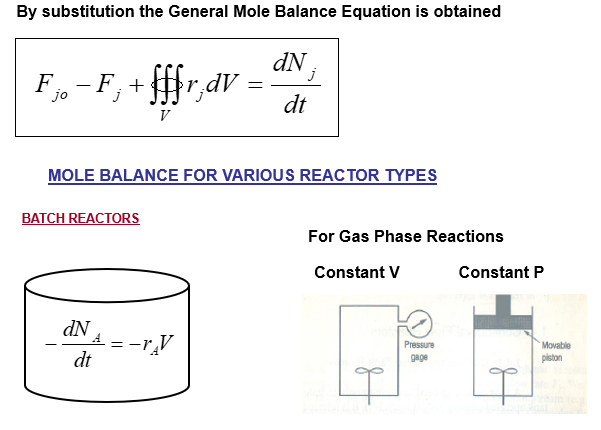
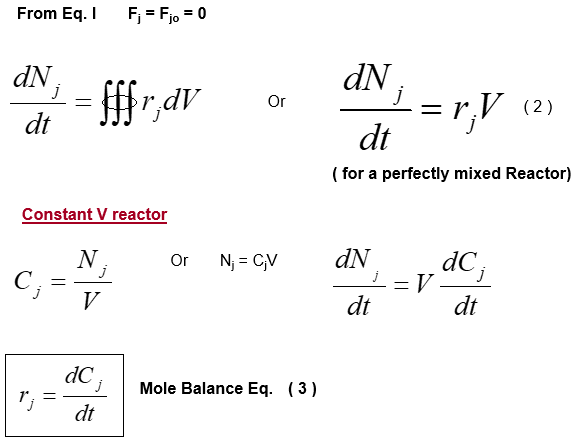
The design of a reactor is determined by many factors but the most important are the thermodynamics and kinetics of the chemical reactions being carried out.
The two main types of reactor are batch and continuous.
Batch reactors are mostly used for the reactions being carried out in a laboratory with the reactants being placed in a test-tube, flask or beaker. They are mixed together, often heated for the reaction to occur and then cooled. The products are poured out and purified if necessary.
This procedure is also carried out in the industrial scale with the key difference being one of size of reactor and the quantities of reactants.
The following image shows a batch reactor.
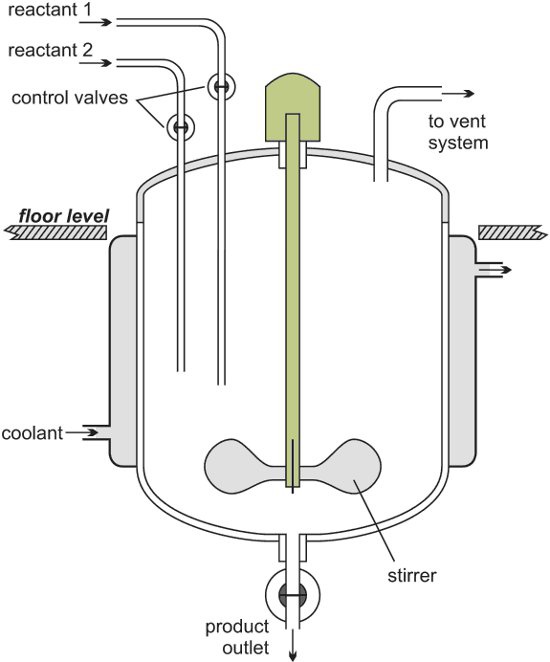
After the reaction, the reactor is cleaned to ready it for another batch of reactants to be added.
Batch reactors are usually used when a company wants to produce a range of products involving different reactants and reactor conditions. They can then use the same equipment for these reactions.
Examples of processes that use batch reactors include the manufacture of colorants and margarine.
Alternatively, the reactant feed can be fed continuously into a reactor at one point, then the reaction occurs in the reactor and the product and byproducts withdrawn from another point. The inlet flow must he equal to the outlet flow.
Softening hard water is an example of a continuous process. Hard water is passed through a tube containing an ion-exchange resin. The reaction occurs down the tube and soft water pours out at the exit. This is summarized below:
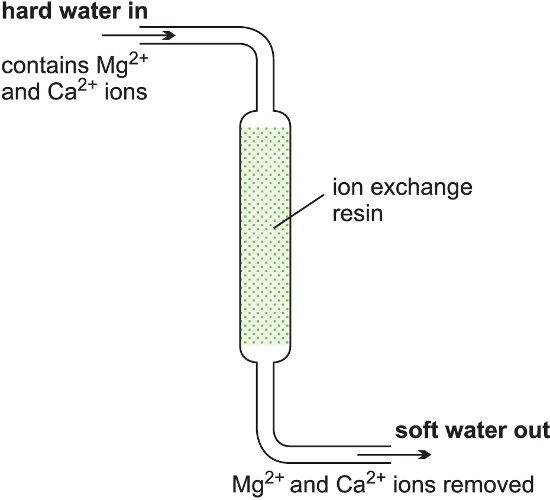
Continuous reactors are general used to produce large quantities of a chemical and needs to operate for several months without a shutdown.
The residence time in the reactor is controlled by the amount of reactant fed into the reactor. Since the volume is fixed, the residence time in the reactor is easy to control.
The products from a continuous process tend to have a more consistent quality since the reaction parameters like residence time, temperature and pressure are easily controlled than in batch operations.
The amount of waste produced is also less and it requires much lower storage of both raw materials and products hence its a more efficient operation. This means that the capital costs per ton of product produced are lower.
The main disadvantage is their lack of flexibility as the reactor built is rarely used to perform a different chemical reaction.
It is described as a fixed bed of catalyst. A heterogeneous catalyst is used where gases flow through a solid catalyst (which is often in the form of small pellets to increase the surface area). The figure below shows a fixed bed reactor.
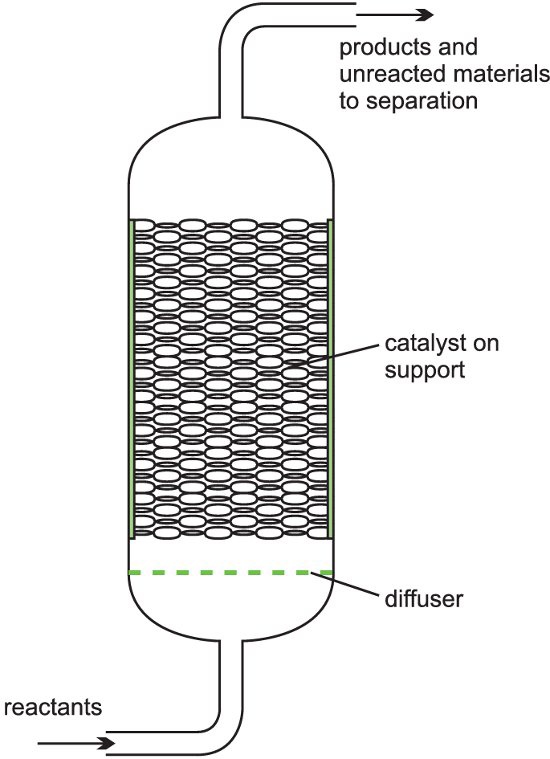
These type of reactors are used in the following processes:
A fluid bed reactor is sometimes used whereby the catalyst particles, which are very fine, sit on a distributor plate. When the gaseous reactants pass through the distributor plate, the particles are carried with the gases forming a fluid. This ensures very good mixing of the reactants with the catalyst, with very high contact between the gaseous molecules and the catalyst and a good heat transfer. This results in a rapid reaction and a uniform mixture, reducing the variability of the process conditions.
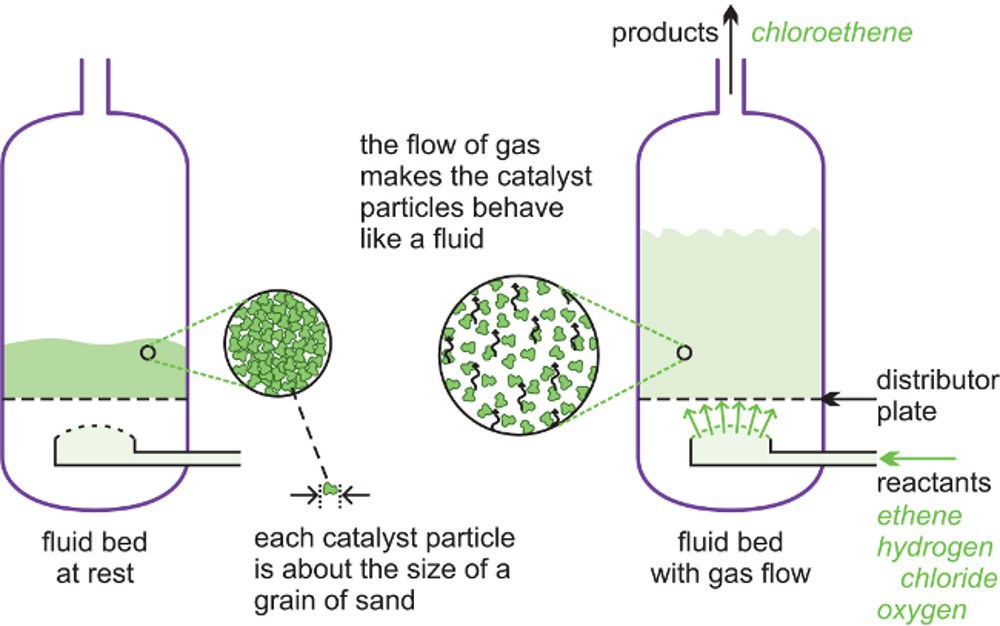
Above is an illustration of a fluid bed reactor. On the left hand side, the particles are at rest. On the right hand side, the particles are now acting as a fluid, as the gaseous reactants pass through the solid.
It is used in the following processes:In a CSTR, one or more reactants are introduced into a reactor equipped with a stirrer and the products are removed continuously. The reagents are stirred vigorously for good mixing to ensure there is a uniform composition throughout. The composition at the outlet is the same as in the bulk in the reactor. These are exactly the opposite conditions to those in a tubular flow reactor where there is virtually no mixing of the reactants and the products. The figure below shows a CSTR.
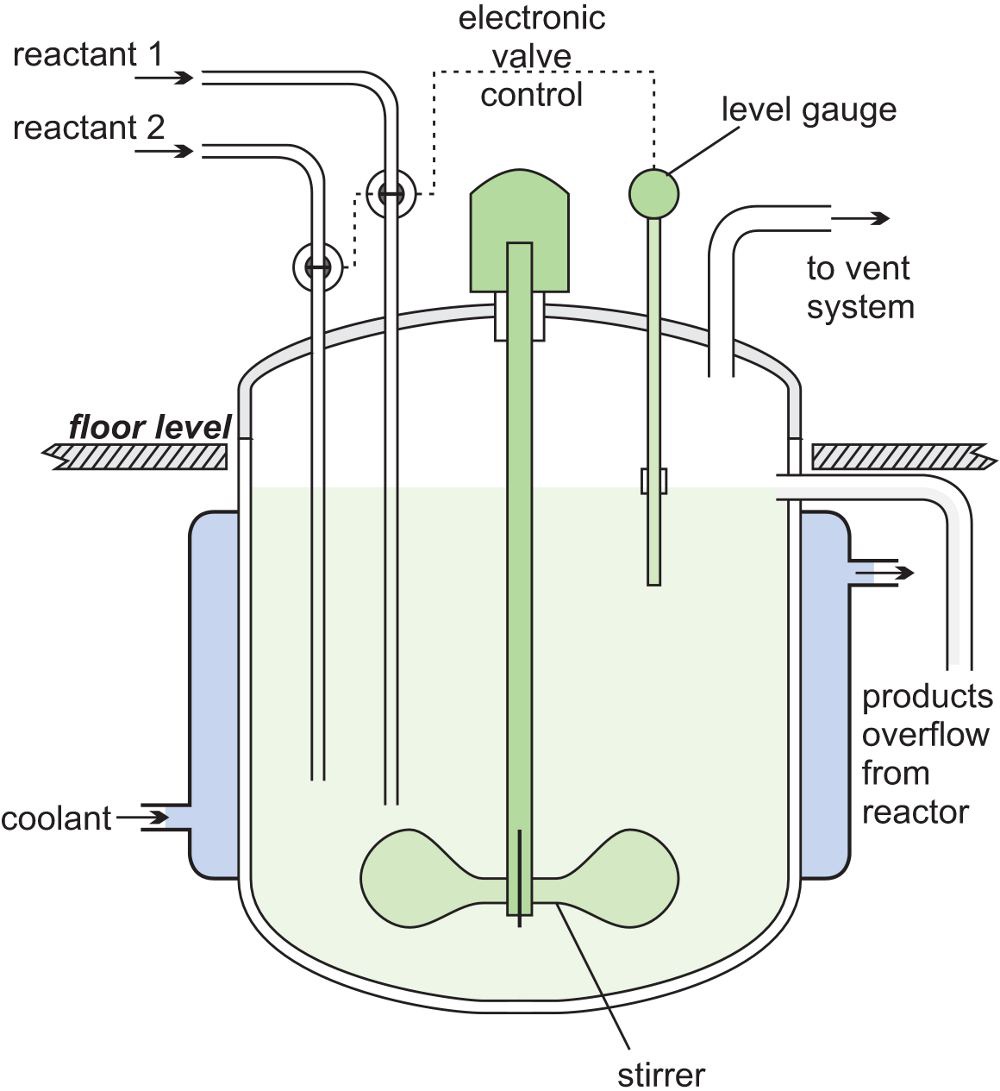
A steady state must be reached so that the flow rate into and out of the reactor are equal or the tank would empty or overflow. The residence time is calculated by dividing the volume of the tank by the average volumetric flow rate.
A CSTR reactor is used in the production of the amide intermediate formed in the process to produce methyl 2-methylpropenoate.
A variation of the CSTR is the loop reactor which is relatively simple and cheap to construct. These are used in the manufacture of poly(ethene) and poly(propene).
Microreactors are the future of chemical production where the size of a reactor is about the size of a desktop computer. The reduced size will lead to reduced capital costs and reduced amount of chemicals used at any one time resulting in safer processes.
The temperature can be kept constant easily due to larger surface area for a volume allowing more efficient heat transfer to the surroundings even for exothermic reactions.
There is considerable amount of research being carried out in developing microreactors. One example is the possibility of the direct conversion of benzene to phenol. A mixture of benzene and oxygen is fed through an alumina tube, packed with palladium at 350-400 K and hydrogen gas is passed over it. The figure below shows a microreactor being used to produce phenol from benzene.
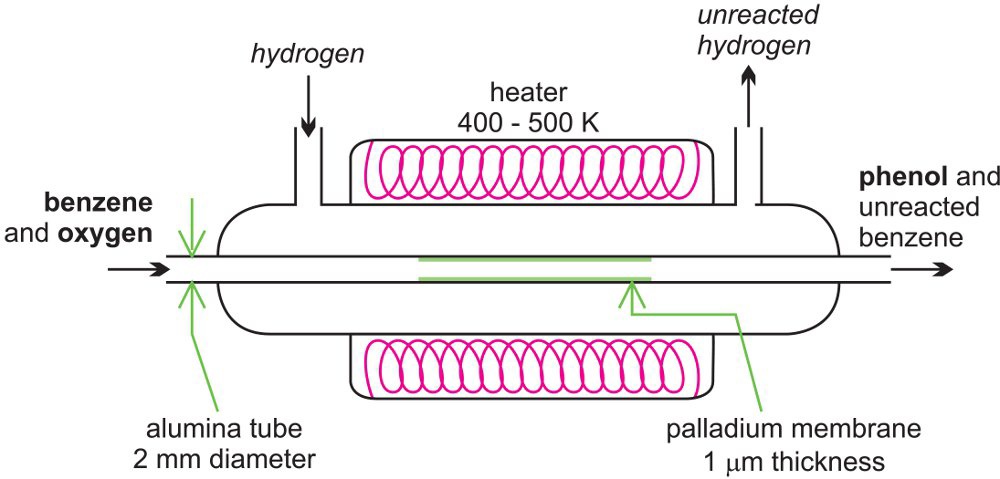
Hydrogen permeates through the alumina tube, and is converted to atomic hydrogen by the palladium catalyst. The hydrogen atoms react with oxygen, releasing reactive oxygen species, such as hydroxyl radicals, which in turn react with the benzene to form phenol.
Another development is known as oscillatory flow mixing. Chemical engineers are designing reactors where the fluids to be reacted are oscillated inside a reactor with baffles at frequencies between 0.5 and 15 Hz with amplitudes in the range 1 to 100 mm. This allows for very effective mixing of the reactants and also for heat to be transferred to the surroundings. This gives similar conditions to those in plug flow which are otherwise difficult to achieve with small quantities of materials.
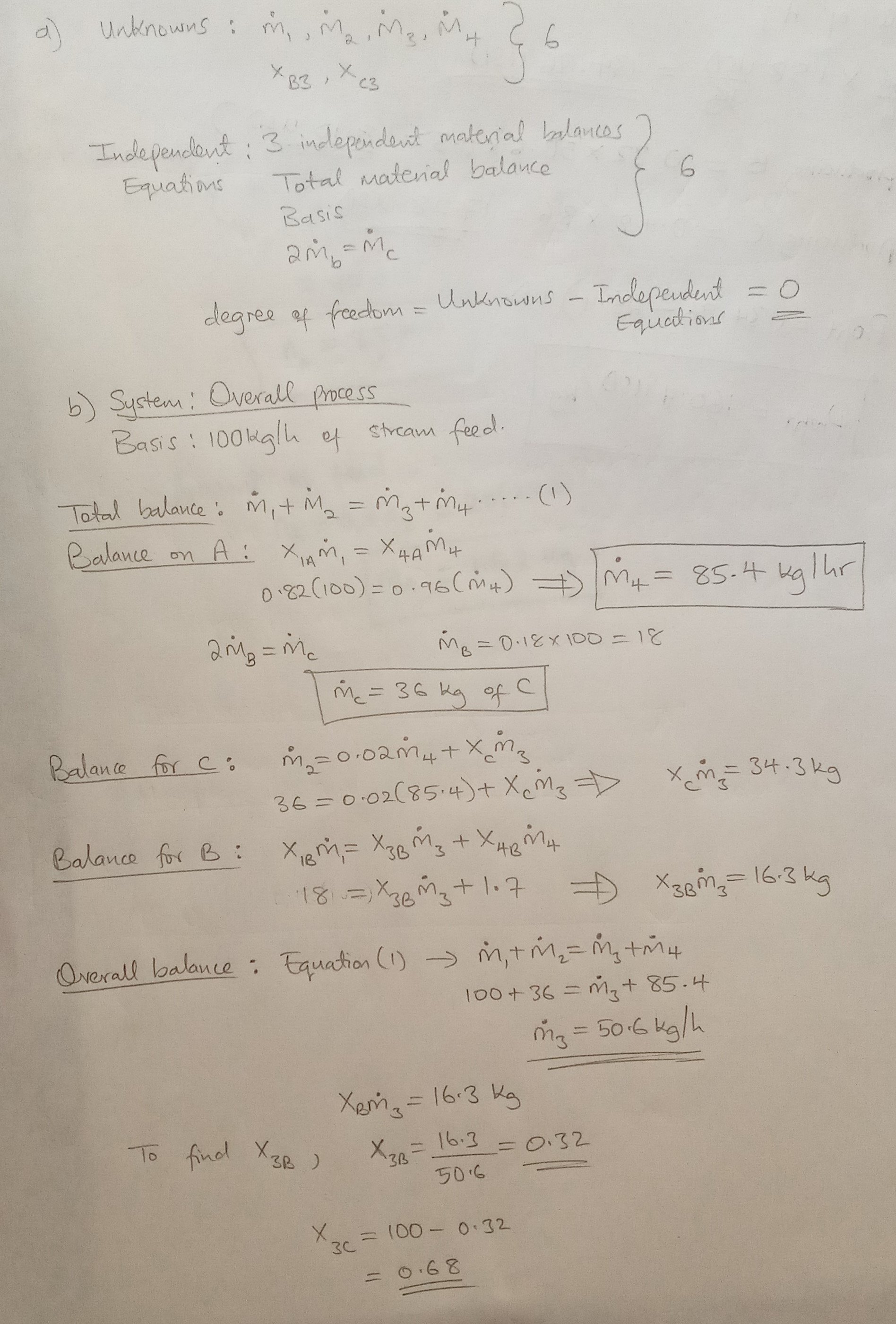
The side product of a chemical company is a mixture with 82 weight % of species A, and the remaining is species B. In this mixture, species A is the valuable component. If this mixture is sold with this composition, its price is 1.12 USD per kg. However, if the percentage of species A can be increased to 96%, the price in the market will be 1.58 USD per kg. It is proposed that a stream of species C will be used to strip the species B as shown below. In this process, 2 kg of C should be used for each kg of B entering the process.

As a chemical engineer, you are requested to show whether this investment is profitable or not. The cost of species C is 0.48 USD per kg and the production cost (including energy, labour, depreciation of equipment and all others) is 0.5 USD per kg of B stripped (i.e. kg of B in stream 3). Follow these steps to solve this problem:
a) Determine the degree of freedom,
b) Determine all the flowrates and compositions,
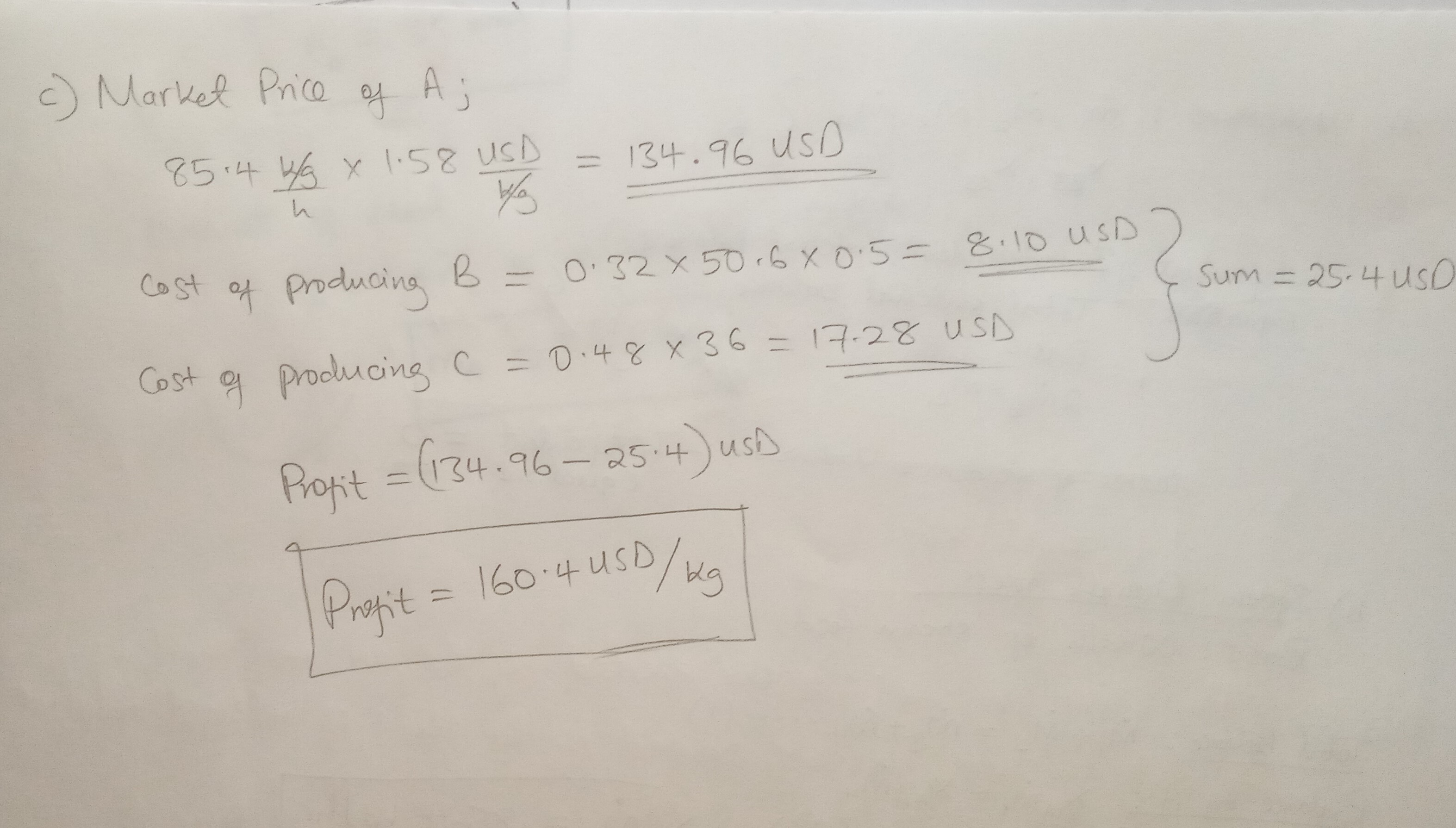
c) Calculate the production cost of stream 4 per kg and compare it with the market price of mixture with 96% species A
CO combines with Cl2 to form COCl2 gas. The feed to a reactor operating at steady state is a mixture of only CO and Cl2. After the reaction the product contains 12 mol COCl2, 3 mol Cl2 and 8 mol CO.
a) What is the percent excess,
b) What is the conversion of the limiting reactant,
c) What is the amount of feed in kg.


Usually, a Chemical Engineer is hired to:
Some of the major parameters in the design of chemical reactors include:
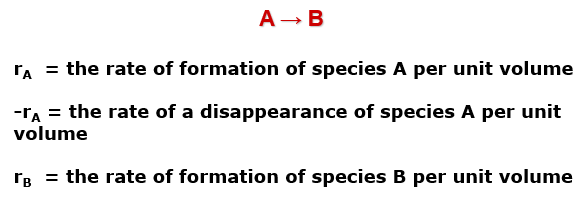
This is the rate at which a species loses its chemical
identity per unit volume. The rate of a reaction can be expressed as the rate
of disappearance of a reactant or as the rate of appearance of a product.
Consider species A being converted to product B:

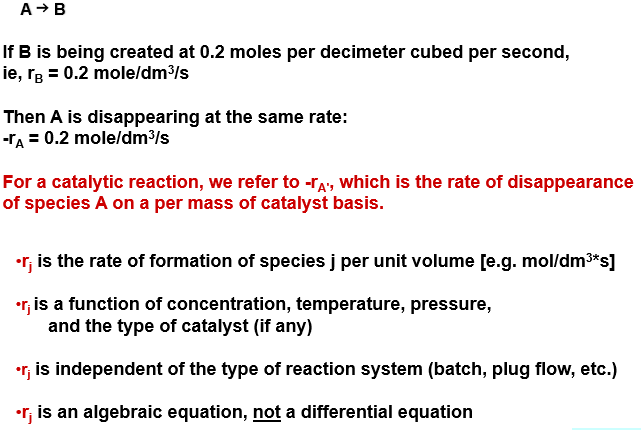
If B is being created at
0.2 moles per decimeter cubed per second, ie,
rB = 0.2 mole/dm3/s
Then A is disappearing at
the same rate:
-rA
= 0.2 mole/dm3/s
For a catalytic reaction,
we refer to -rA, which is the rate of
disappearance of species A on a per mass of catalyst basis.
Let’s assume that rj
is
the rate of formation of a species j per unit volume e.g., mol/dm3*s.
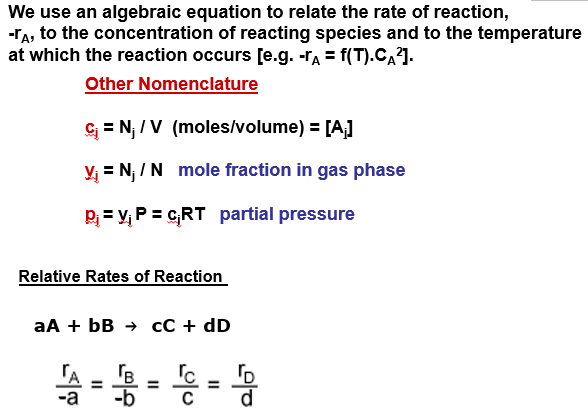
The rj is:
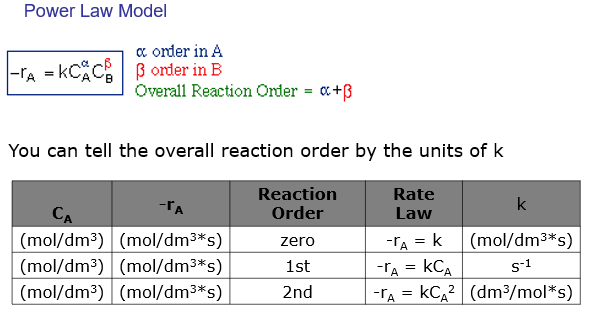
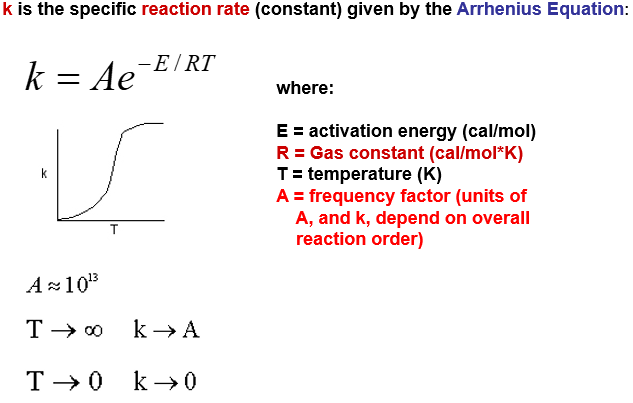
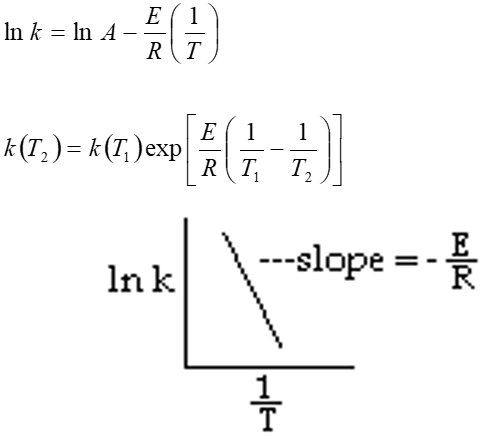
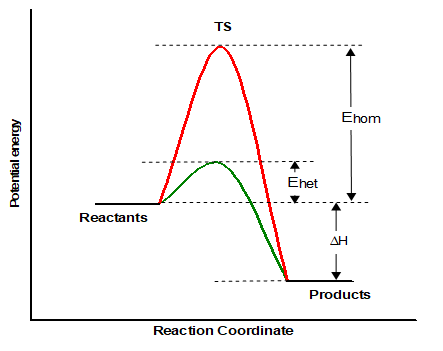
Catalysts are an important aspect of reaction engineering.
They alter the speed of a reaction by lowering the activation energy of a
reaction. The activation energy of a reaction is the amount of energy needed to
produce a forward or reverse reaction. In the following figure we can see the
activation energy of a non catalytic reaction (red line), while the green line
represents the same reactions activation energy when a catalyst is used.
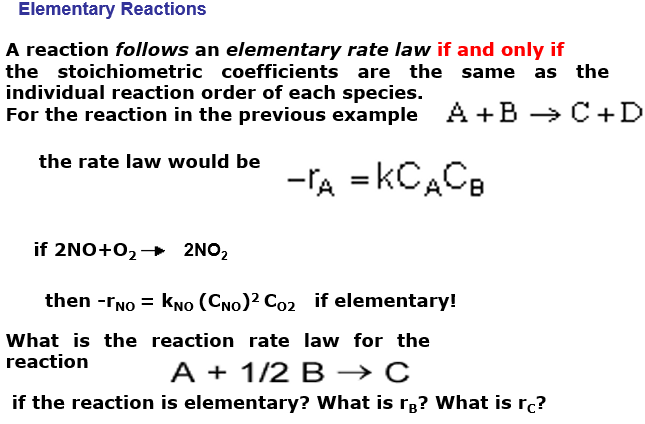
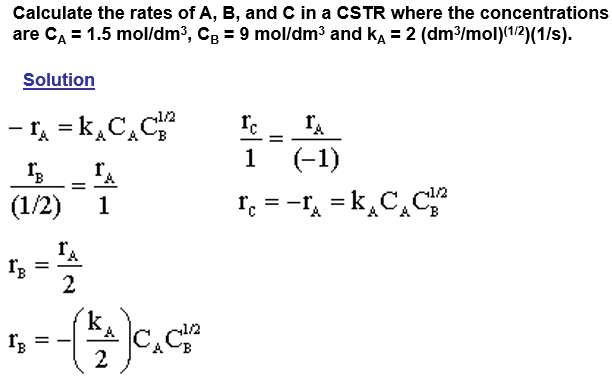
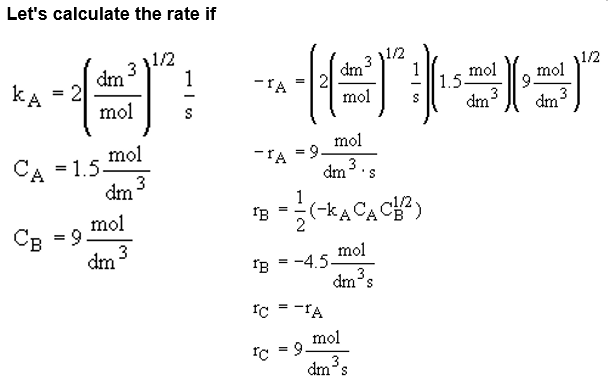
Examples
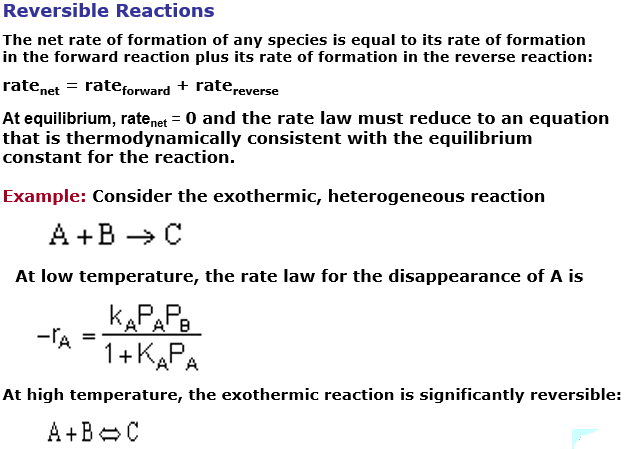
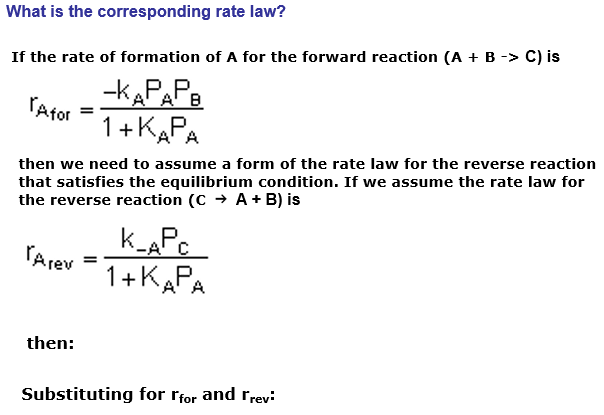
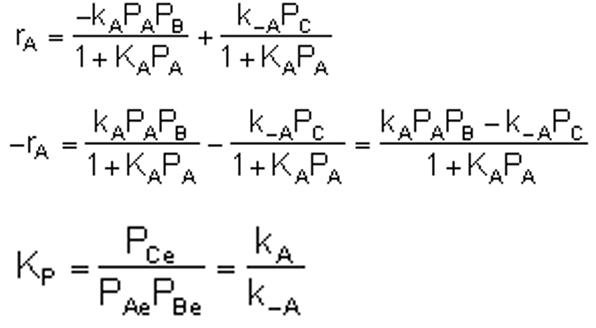
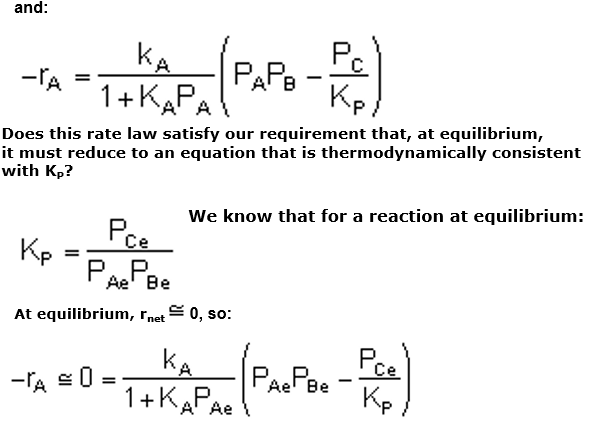
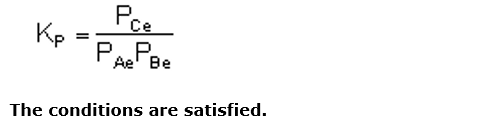
What are reversible reactions?
Force
Force
is defined using Newton’s second law of motion which states that the net force Fnet
acting on a body of mass m, is proportional to the time rate of change of its
momentum. If the mass is constant, the net force is proportional to the product
of the mass of the body and its acceleration. Thus,

Pressure
The
pressure, P, of a fluid on a surface is defined as the normal force exerted by
the fluid per unit area of the surface, i.e.,

Pressure
has the units of Pa (N/m2) in SI units. Absolute pressure
refers to the absolute value of the force per unit area exerted on the containing
wall by a fluid. Gauge pressure is the difference between the absolute pressure
and the local atmospheric pressure. Vacuum represents the amount by
which the atmospheric pressure exceeds the absolute pressure. This can be shown
schematically:

From these definitions we can see that:
A
system is said to be in mechanical equilibrium with its surroundings
when there is no pressure difference between them, i.e.,
Psys
= Psurr Condition
of mechanical equilibrium
Isobaric
Process: This is a process that takes place at constant
pressure. It is important to note that if the initial and final states are
at the same pressure, this does not necessarily imply an isobaric process.
Example
1
Which
of the following processes would you consider to be isobaric for analysis purposes?
a)
A valve is opened in a tank of compressed air. (Non-isobaric process)
b)
Heat is added to boiling water on the stove. (Isobaric Process)
c)
Air is compressed in a compressor. (Non-isobaric process)
d)
A tank of compressed air leaks air through a tiny pinhole leak. (Non-isobaric
but if short time periods are involved, it may be considered isobaric)
e)
The air in the cylinder with a frictionless piston held by a constant weight on
it as heated. (Isobaric Process)
To give a clear representation of a state function, it is often helpful to investigate the two theorems on exact differentials.
If

Provided that M and N have continuous derivatives:
Proof: The total
derivative of the function φ can be expressed in the
form:

Comparison of the above two
dφ
equations
can be expressed as:

Since the right-side of the last two equations are equal to each other, then:

Thus, the representation,
M dx + N dy can be written as the differential of φ,
i.e., dφ,
often called an exact differential.
A necessary and sufficient condition for M dx + N dy to be independent of the path C joining any two points A and B is that:

A system is any region that occupies a volume and has a boundary. The volume outside of this boundary is referred to as the surroundings of the system. The sum of the system and its surroundings is called the universe. Thermodynamics considers systems only at the macroscopic level. Systems can be divided into three general types:
Since the equations available to analyze closed and open systems differ from one another, it is important to properly define a system.
In order to describe a system we need to know the quantities that characterize it. These quantities are called properties and include volume, mass, temperature, pressure, etc.
A complete list of the properties of a system describe its state.
Thermodynamic properties are considered to be either intensive or extensive. A property is considered to be extensive if it is proportional to the mass of the system e.g., volume, kinetic and potential energy. An intensive property is independent of the systems mass e.g., viscosity, density, temperature, pressure, mole fraction and refractive index.
An easy way to visualize this is to divide a system into two equal parts. Each of the part will have the same value of intensive properties (T , P , ρ) as the original system, but will have half the value of the extensive property (V) as shown in the figure below. In short, extensive properties are additive while intensive properties are not.

Specific properties are extensive properties divided by the total mass or total moles of the system, i.e.,

Note: All specific properties are intensive.
The
Degrees of Freedom are the number of
independent intensive variables needed to specify the state of the system. The
Gibbs phase rule specifies the number of degrees of freedom (F) for a system at
equilibrium and is expressed as follows:
P
+ F = C + 2
where
P is the phase number and C is the number of components.
Thus,
is you are working with a single phase, one component system, you need to
specify two independent intensive properties. Two properties are independent if
one property can be varied while the other is constant. For example,
temperature and density are always independent properties and together they can
fix the state of a single-phase, single-component system.
This
can be defined as any mathematical relationship between the variable T, P and V.


Using the above equation we can now plot two-dimensional graphs of f
(T, P, V) = 0 for an ideal gas.

Process is a change of state that can occur in numerous ways. Work and heat can only occur during processes and only across the boundary of the system. The curve describing the process is called a process path. If the final state is the same as initial state, then the overall process is called a cyclic process.
State
functions are an important thermodynamic concept. If the magnitude of a
thermodynamic property depends only on the initial and final states and is
independent of the path being followed then its known as a state function.
Otherwise, it’s called a path function. All the thermodynamic variables
are state functions except heat and work.
Some
characteristics of state functions are:
(i). will be different (Δφ ≠ 0),
(ii). will depend on the cyclic path being used,
(iii). will be different for every path.
This
means the dependent variable does not change as a function of time. If the
dependent variable is φ, then:

Uniform
This
means the dependent variable is not a function of position. This means that all
three of the partial derivatives with respect to position be zero, i.e.,

The variation of a physical quantity with respect to its position is called a gradient. Thus, the gradient of a quantity must be zero for a uniform condition to exist.
A
system is considered to be at equilibrium if both steady-state and uniform
conditions are met simultaneously. This means that the systems properties like
temperature, density, pressure are constant at all time. Equilibrium has the
following characteristics:
Equilibrium
can be classified into 4 classes that can easily be conceptualized using the
analogy of a ball on a solid surface being acted on by gravity.

In
thermodynamics only systems with stable equilibrium states are considered in
their initial and final stable equilibrium states to determine the heat and work
interactions with its surroundings.

From the previous chapter, we saw that the continuity equation is a conservation of mass equation with which mass transfers across boundar...


