Chemical Engineering Tutorials

Wednesday, 19 June 2024

Diffusion in Mass Transfer

 Mass Transfer is the net movement due to a concentration gradient of a component in a mixture from one location to another. Generally, this transfer occurs between two phases across an interface. Mass transfer can also be defined as the selective permeation through a non-porous polymeric material of a component of a gas mixture.

Mass transfer models can be used to describe processes like the passage of a species through a gas to the outer surface of a porous adsorbent particle and into the pores of the adsorbent, where the species is adsorbed on the porous surface.

Mass transfer occurs through two basic mechanisms:

(a) Molecular diffusion by random and spontaneous microscopic movement of individual molecules in a gas, liquid, or solid due to thermal motion

(b) Eddy (turbulent) diffusion by random macroscopic fluid motion.

Molecular Diffusion vs. Eddy Diffusion

Both diffusion types involve different species moving in opposite directions. When a net flow occurs in one of these directions, the total rate of mass transfer of the individual species is increased or decreased by this bulk flow or convection effect, which is a third mechanism of mass transfer.

Molecular diffusion is extremely slow, while eddy diffusion, when it occurs, is orders of magnitude more rapid.

Molecular diffusion typically occurs in solids and fluid involving stagnant, laminar or turbulent flow while eddy diffusion occurs in fluids with turbulent flow.

  • In a binary mixture, molecular diffusion occurs due to one or more driving forces like:
  • differences in concentration (ordinary diffusion)
  • pressure (pressure diffusion). This requires a large pressure gradient which is achieved for gas mixtures with a centrifuge.
  • temperature (thermal diffusion). Temperature gradients can be achieved by using thermal diffusion columns to separate liquid and gas mixtures
  • external force fields (forced diffusion) that act unequally on the different chemical species present. This is achieved by using an electric field to cause ions of different charges to move in different directions at different speeds

When both molecular diffusion and eddy diffusion occur, they take place in parallel and are additive. Furthermore, they take place because of the same concentration gradient. 

Describing diffusion quantitatively

Assume that molecule A is diffusing between boundary 1 and 2 with fixed concentrations cA,1 and cA,2 respectively. The rate of diffusional mass transfer (moles/time) across an area, A, can be determined. A represents an area of y by z in the following illustration:


Fick’s Law of Diffusion

The concentration profile is linear for any system with only pure diffusion (no convection, no reactions, constant properties). Thus, Fick’s law can be approximated as:


The driving gradient for diffusional mass transfer is the difference in concentrations i.e., cA,1 - cA,2

Variable

Definition

Units

A,x

moles of species A transferred per unit time from location 1 to location 2

mol/s

DAB

the diffusion coefficient of species A through medium B

m2/s

A

the area through which transfer occurs

m2

cA,1 - cA,2

the concentration gradient between locations 2 and 1

mol/m3

x2-x1

The distance between locations 2 and 1

m


NOTE: the area for mass transfer is not the ‘edge-view’ area but the ‘face-view’ area. This is the area used in Fick’s Law and Fourier’s Law calculations:


In some cases, mass transport occurs through a porous membrane with a pore fraction of εpore. In such cases, the actual area available for mass transfer is only the porous fraction of the total, and thus,

A = Aapparent εpore

Diffusion Coefficient

The diffusion coefficient, DAB, is a proportionality constant between the molar flux due to molecular diffusion and the gradient in the concentration of the species.

Theoretically, the diffusion coefficient is proportional to the mean squared displacement divided by the time elapsed: 

The value of the diffusion coefficient is determined through experiments, theory and estimation

The properties that influence the diffusion coefficient of molecule A in solution B are:

  • molecular weight of A and/or B,
  • molecular size of A and/or B,
  • molecular properties like charge, ionic strength, dipole moment of A and/or B,
  • temperature,
  • pressure.

Equimolecular counter diffusion

This occurs when the mass transfer rates of the two components are equal and opposite.

It occurs in the case of the box with a movable partition and also in a distillation column when the molar latent heats of the two components are the same (λA = λB).


Tuesday, 11 June 2024

Definition of Flux Terms in Mass Transfer

Flux is defined as the amount of a quantity that is transported per unit time across a unit area that is perpendicular to the direction of transport. The molar flux of species i with units’ moles/m2.s is represented as:

Where:

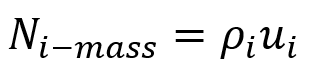
Ni-mol is the molar of species i

ui is the velocity of i with respect to a fixed reference frame.


Similarly, the mass flux, Ni-mass, with units mass/m2.s is represented as:


In some cases, it is convenient to interpret the total flux of species i with respect to an arbitrary reference frame rather than a fixed set of reference frame.

The molar flux of species i based on an arbitrary reference velocity u0 is denoted by Ji-mol and is defined as:


Similarly mass flux of species i based on arbitrary reference velocity u0 is denoted by Ji-mass which can be expressed as:


In a system a frame of moving reference must be chosen, since several molecular species move with different average velocities. The important moving references are mass average, molar average and volume average velocities.


Mass average velocity

This can be defined in terms of the mass concentration and the velocity of species i based on a fixed axis. It is expressed as:


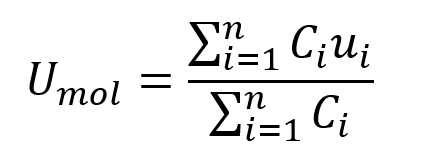
Molar average velocity

This can be expressed by the expression analogous to the mass average velocity. It can be represented by replacing the mass concentration of species i, ρi with the molar concentration of species i, Ci:


Volume average velocity

This is important for experimental analysis in a fixed system of constant volume. The volume average velocity can be expressed by:


where vis the partial molar volume of species i.

Relation Between Fluxes

The molar flux of species i described previously can be obtained with respect to the molar average velocity as follows:

Substituting the molar flux of species i into the above equation and rearranging it results in:

Substituting the definition of molar average velocity into the above equation we get:

or:


Tuesday, 4 June 2024

Definition of Concentration Terms in Mass Transfer

For a particular species, its concentration can be expressed in several ways.

In mass transfer applications, the only driving force is the concentration gradient while other driving forces like temperature and pressure gradients are kept constant. There needs to be a gradient of chemical potential between two points to create a driving force that allows mass transfer to occur.

A concentration gradient is a spatial difference in the abundance of the chemical species.

A concentration profile is a sketch indicating the magnitude of the concentration as a function of position and is often superimposed on a process to indicate where these changes occur. It is analogous to the velocity profile in fluid flow examples and illustrated below:


Mass concentration or molar concentration of components and mass or mole fraction of species are used to express concentration gradients.

Mass Concentration

For any species i, the mass concentration is expressed as ρi. It is defined as the mass of i per unit volume of a multi-component mixture. This is expressed as follows and has the same units as density:

Total mass concentration within a mixture is equal to overall density which can be expressed as follows, where n is the number of species in a mixture:


Mass Fraction

The mass fraction of species i (wi) is the ratio of mass concentration of species i to the total mass density and can be expressed as:

From the definitions used for mass concentration into the above equation, we obtain the following expression:


Molar Concentration

The molar concentration (Ci) of component is the number of moles of the ith component per unit volume of mixture. The total concentration in the system can be obtained by adding up all the molar concentrations of all the species in the mixture and is represented as:


To convert from mass to molar concentration, divide the mass concentration of species i by its molar weight. For an ideal gas mixture, the molar concentration of species i can be obtained from the ideal gas law (PV = nRT) as follows:

Where:

  • ρi is the partial pressure of species i in the mixture,
  • T is the absolute temperature,
  • R is the universal gas constant. 

Thus, the total concentration in the gaseous system can be represented by:


Mole Fraction

The mole fraction of species i in a mixture is found by dividing the molar concentration of species i by total concentration in the system and is expressed as;

and


The summation of mole fractions of species in a mixture always adds up to 1 as shown:


Monday, 3 June 2024

Introduction to Mass Transfer II

 As previously defined (Click hereMass transfer is the movement of components under a chemical potential gradient from an area of high concentration to that of a lower concentration. Once the gradient equals zero then equilibrium is established.

Mass transfer depends on the diffusion of molecules from one distinct phase to another. It is based on the differences in physical and/or chemical properties of the molecules in motion. These properties include solubility and vapor pressure. For interphase mass transfer, a concentration gradient exists between the bulk and interface. Under steady state conditions an interface equilibrium is assumed. An interface is the boundary between different phases.

Many industrial processes depend on mass transfer which aids in the movement of materials from one homogeneous phase to another. These include:

Adsorption and desorption – This process uses the ability of molecules to move from either gas or liquid phase to the surface of solid particles. Adsorption does not qualify as a true inter phase mass transfer operation as the fluid adheres to the solid surface instead of dissolving in the solid. Desorption is the opposite of adsorption as mass transfer occurs from the solid surface (adsorbent) to the liquid or gas phase (adsorbates).

This process is applied in:

  • Removing toxic gases and smells from the air.
  • Solvent recovery
  • Removing ions from solutions

Adsorption is also discussed here.


Absorption and stripping – Absorption is the transfer of materials from a gas to a liquid phase. The gas is absorbed by a liquid in which the solute gas is more or less soluble from its mixture with an inert gas, as well as more or less insoluble gas. The liquid is immiscible in the gas phase. An example of absorption is the separation of ammonia from an air-ammonia mixture using water with the solute recovered from the solution using distillation. Absorption is also discussed here.

Stripping is the separation of a gas solute from a liquid phase.


Distillation – This is a process where a miscible, volatile liquid mixture is separated into its individual components using partial vaporization. The components vaporize when their boiling points are reached then are condensed into their liquid states. This is widely used in the purification of crude oil into gasoline, kerosene, fuel oil and lubricating oil.

In industrial applications, distillation commonly occurs in a distillation column. Some majore aspects of a distillation column are discussed here.


Extraction – This is a process where the separation of the constituents of a liquid solution is achieved by contact with another insoluble liquid. The liquid used to achieve this process is called a solvent while the solution to be extracted is called a feed. The product which is solvent rich is referred to as the extract while the residual liquid from which the solute is removed is called the raffinate.

Real world applications include the separation of aromatics from kerosene-based fuel oils, the production of fuels in the nuclear industry and the separation of penicillin from fermentation mixtures.


Leaching – This is the treatment of finely divided solids with a liquid.

Examples include oilseed extraction, extraction of sugar beets with hot water and extraction of medicinal compounds from plant roots, leaves and stems.


Humidification and dehumidification – Humidification refers to the increase of the vapor content of a gas stream by passing it over a liquid. Dehumidification on the other hand, involves the transfer of water vapor from the gas phase to the liquid phase. 


Membrane separation – This process involves the diffusion of a solute from one fluid stream through a semi-permeable membrane into another fluid stream. The components are selectively separated from the original solution from one side of the membrane to the other.

A membrane can be defined as a heterogeneous phase acting as a barrier to the flow of molecules and ionic species in liquid or vapor phases. If one component of the mixture travels faster in the membrane, a separation can be achieved. Based on their nature, heterogeneous barrier membranes can be classified into solid and liquid membranes.

Reverse osmosis and electrodialysis are examples of process that use membrane separation.


Crystallization – This is a process where a solid is formed from a liquid solution based on the difference in the solute concentration and its solubility at a certain temperature. In this process the solute transfer occurs from the liquid solution to a pure solid crystalline phase. When the concentration of the solute becomes higher than its solubility at a certain temperature, then the solute comes out of the solution is the form of a crystal.

Salt is extracted from sea water using crystallization.


Drying and Evaporation – Drying is the process of removing a small amount of water or other liquids from a solid material. The water is removed at a temperature below the boiling point of water by circulating air or another carrier gas over the material.  Evaporation is the removal of a large amount of water from solutions. The water is removed as a vapor at its boiling point.


In summary:

Separation Process

Separating Agent

Typical Applications

Adsorption

Adsorbent Solid

Separation of organics from gas.

Gas Absorption & Stripping

Solvent

Removal of CO2 from synthesis gas and CO2 and H2S from natural gas.

Distillation

Heat

Fractionation of crude oil.

Liquid-liquid Extraction

Solvent

Removal of aromatics from gasoline.

Solid-liquid Extraction

Solvent

Extraction of caffein from

coffee.

Membrane separation

Membrane

Desalination of water.

Crystallization

Removal of heat

Production of salts and sugar.

Drying

Heat/Drying gas

Drying of fruits and polymer beads.


Wednesday, 15 May 2024

Hydrogen Storage and Transport

Hydrogen provides and excellent decarbonization opportunity for several industries like steel and cement production, power generation, heating, refining amongst others with more and more industries starting to use hydrogen for its environmentally friendly nature. 

This has developed a need for safe storage and transportation of this important material. 

The common practice in the past was producing hydrogen wherever it was needed. However, as the use of hydrogen changes and expands so does the need for transportation. 

While determining the best method for storage and transportation of hydrogen, safety and economics must be considered. A major challenge that needs to be overcome is the extreme pressure and temperature needed for storage and transportation. 

Storage mechanisms for hydrogen in both gas and liquid form

1) High pressure gas cylinders

This is the most common hydrogen gas storage technique. It is done at high pressures (250 to 700 bar). This can be used for on-site storage as well as transportation of hydrogen using trucks. The permeability of the material selected for these tanks should be considered before being used. 

2) Super-insulated low pressure liquid cryogenic storage vessels. 

This is for liquid forms of hydrogen at 1 atm and - 252°C to prevent boil-off and product loss inside insulated tanks. This however has a large energy cost but allows for efficient transportation of large quantities of hydrogen over large distances including via ships.

3) Naturally occurring or specially engineered underground bulk storage. 

4) Alternative molecules.

Hydrogen can also be stored by converting it into ammonia, methanol or ethanol in order to use existing storage systems. These chemicals do not require high pressure or low temperature storage. Thus helps reduce the cost to obtain special storage and transportation vessels. Liquid organic hydrogen carriers (LOHCs) which are compounds that can absorb and release hydrogen through reactions can also be used for effective storage and transportation. LOHC technology enables easy fueling of the fuel cell electric vehicles. 

5) It can also be stored by adsorption on the surface of solids and absorption within solids.

Challenges during the handling of Hydrogen

1) Detecting leaks and managing safety concerns. 

Safety is always of paramount importance for any chemical process for the protection of employees and plant infrastructure. Even though hydrogen is non-toxic, it is extremely flammable. It has a combustible range between 4 - 74% in air as compared to natural gas which has a range between 5 - 20%. 

A safer environment can be ensured by conducting hydrogen leak tests and flames detection. 

2) Minimize product loss

It is vital to measure and verify the amount of hydrogen as it moves through the supply chain through pipelines, loading and offloading sites and storage units. This allows minimization of theft and detection leaks to prevent loss of product and ensure safety of all around the supply chain.


3) Ensure hydrogen purity

The end use of hydrogen determines the purity required. The quality of hydrogen for uses like heavy duty transit is different from the requirements for blending into natural gas. 

Thus it is vital to understand the purity of the hydrogen being produced, moved and used in order to ensure safety and meeting the customers  requirements. 

This can be mitigated by use of gas analyzers to check the purity of hydrogen through every step of storage and transport. 


Transportation of Hydrogen

Factors like distance, geography, cost, energy loss and end use are key factors that determine which transportation method is efficient in hydrogen movement to the point of use. These methods include:

1) Pipelines

They offer a way to deliver large volumes of hydrogen. Pipes used to distribute natural gas can also be used to transport hydrogen blended with natural gas.  

2) Trucks

Hydrogen tankers can be used to transport compressed hydrogen in high pressure tube trailers or liquefied hydrogen in a cryogenic storage unit. This method allows for quick deployment and endless flexibility. 

3) Ships

This allows for long distance transportation using the oceans or seas. Cargo vessels can be retrofitted to allow safe shipping. These ships look similar to Liquefied Natural Gas (LNG) tankers. The difference with LNG is the construction materials and instruments used for process optimization and safety monitoring. 

4) Alternative molecules.

Similar to using alternative molecules for hydrogen storage, hydrogen can be converted into an alternative molecules like methanol, ethanol or ammonia or LOHC to allow easy and safe transportation by allowing ambient temperatures and pressures for handling. In this method, the hydrogen should be reconverted back into hydrogen at the consumption point. 

Hydrogen leaks

In order to ensure safety, minimize product loss and ensure compliance with regulations, quick leak detection in pipelines and storage units is extremely important and can be very difficult since hydrogen flames are invisible to the naked eye and conventional flame detection is risky for workers. 

Multi-spectrum Infrared Hydrogen Flame Detectors are effective in detecting any hydrogen leaks even from a long distance and provides fast response and with reduced false alarms. 


Monday, 6 May 2024

Examples of Unsteady-State Applications

Example 1

An insulated rigid tank of volume 0.3m3 is connected to a large pipeline carrying air at 1400 kPa and 300°C. The valve between the pipeline and the tank is opened and the tank fills with air until the pressure is 1400 kPa and then the valve is closed. Determine the final temperature of the air in the tank if:

a) The tank is initially empty,
b) The tank initially contains air at 350 kPa and 139°C.


Solution

Assume the system is the contents of the tank. 


Example 2

A rectangular steel tank having an internal volume of 1m3 contains air at 2.5MPa and 20°C. A relief valve is opened slightly allowing air to escape to the atmosphere. The valve is closed when the pressure in the tank reaches 350 kPa:

a) Calculate the amount of heat that must be added so as to keep the tank contents at 20°C throughout the process.

b) Calculate the final temperature if the process takes place adiabatically.

Solution


Note:

The result of equation 14 informs us that the gas that remains in the tank undergoes a reversible adiabatic expansion. Hence, the problem can be solved by choosing the contents of the tank in the final state as the system. The same amount of gas occupies less volume at the initial state as shown:


This is a closed system and since the gas on one side of the imaginary boundary has the same temperature as the gas on the other side we can assume the system is adiabatic as no heat is exchanged across the boundary. 

Furthermore, with the exception of the region around the valve - which is outside our chosen system - the gas in the cylinder is undergoing a uniform expansion thus there is no pressure, velocity or temperature gradients within the cylinder. Thus it can be assumed that the changes occurring in the system are reversible. 


The Heat Diffusion Equation

It is important to know the temperature distribution as it allows us to see how temperature varies with position inside a medium. Once the d...