A condensation reaction is a type of a reaction where two molecules combine to form a single molecule, often water, is then removed from the reaction. For example, when two amino acid molecules combine in a condensation reaction, a covalent bond forms between the amine nitrogen of the first amino acid and the carboxyl carbon of the second amino acid. This results in a molecule of water being removed as a product. This is illustrated below:
Monday, 26 June 2023
Condensation Reactions
Monday, 12 June 2023
Short Notes #7
Catalysts
These are extremely important substances or materials used in numerous chemical processes.
Catalysts are substances that increase the reaction rate without it itself being consumed in the process. Thus, catalysts do not appear in the overall stoichiometric reaction it is used it but appears in the elementary reactions in the mechanism for the catalyzed reaction.
Examples of catalysts:
- Enzymes - These are proteins that act as catalysts in biochemical reactions.
- Homogeneous catalysts
- Heterogeneous (or surface) catalysts
Poison: A substance that reduces the efficiency of a catalyst. For example lead compounds poison platinum catalysts.
Homogenous Catalysis:
This is a process where a catalyst that is in the same phase from the reactants. Typically, everything will be present as a gas or contained in a single liquid phase.
Heterogeneous Catalysis:
This is process where a catalyst that is in a separate phase from the reactants. Typical examples involve a solid catalyst with the reactants as either liquids or gases.
Most examples of heterogeneous catalysis go through the same stages:
- One or more of the reactants are adsorbed (stick) on the surface of the catalysts on special locations called active sites (part of the surface where adsorbed materials can react with one another).
- Interaction between the catalyst surface and the reactant molecule making them for reactive through weakening of bonds in the attached molecules.
- The reaction occurs. Both the reacting molecules may attach to the surface or one might attach and the other moving freely in the liquid or gas medium.
- The product molecules desorbs from the catalyst surface i.e. breaks free from the catalyst surface to allow other reacting molecules to attach themselves and the reaction cycle starts again.
Effects of Catalysts
Catalyst lower the activation energy for a reaction. Activation energy is defined as the minimum amount of energy that is needed to a chemical reaction to occur. This is illustrated in the graph below.
Wednesday, 24 May 2023
Short Notes #6
Thermal conductivity
Thermal conductivity is very similar to specific heat as both are resistances to heat transfer, however they are not the same. While thermal conductivity gives the rate of heat exchanged in a process, the specific heat gives the quantity of heat exchanged in a process. The inverse of thermal conductivity is thermal resistance.
Thermal conductivity is generally expressed as a scalar quantity and its most general form is a second-rank tensor. Since thermal conductivity is a function of the motion of free electrons it is an intensive property since its a property of a material.
Thermal conductivity is affected by temperature and phase change.
Thermal conductivity is used in calculations for heat conduction using Fourier's Law (click here for Fourier law summary). Fourier's law states that the heat transfer rate through as material is proportional to the negative gradient of temperature change to the length which is perpendicular to that gradient, through which the heat flows.
Steady-state conduction is the form of conduction that occurs when the temperature difference driving the conduction is constant.
Thermal conduction is the transfer of internal energy by microscopic collisions (kinetic energy) of particles (molecules, atoms and electrons) and the movement of electrons within a body. Conduction occurs in all phases: solid, liquid, and gas.
Factors influencing conductivity in solids:
- Chemical phase: When a material changes phases, the thermal conductivity may greatly change as well.
- Temperature: For metals and non-metals, the effect of temperature on thermal conductivity differs. For metals, conductivity occurs due to free electrons. For metals, thermal conductivity is approximately proportional to the absolute temperature times the electrical conductivity. As temperature approaches absolute zero, the thermal conductivity sharply decreases.
Thermal conduction of gases: Heat transfer occurs through collisions of gas molecules. In the absence of convection, thermal conduction through a gas phase greatly depends on the composition and pressure of this phase, and the mean free path of gas molecules relative to the size of the gas gap.
Thermal conduction of liquids: For liquids, the details of the thermal conduction mechanisms are not properly understood.
Monday, 22 May 2023
Interpolation of the Values in Using Property Tables
Many times, the state of a system does not fall exactly at a value reported in Steam Tables. This is when interpolation is required between the two adjacent properties on a given table. Let us assume that the properties φ1 and φ2 are given at temperatures T1 and T2, respectively. To determine the value of φ at any temperature between T1 and T2, we assume a linear variation of φ with respect to temperature between T1 and T2 as shown in the graph below:
By integrating the slope
of the interpolation line we can develop an expression for our interpolation as
shown below:
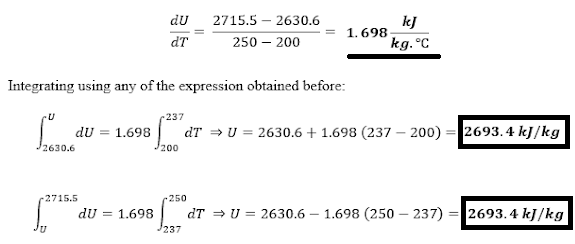
Example:
Calculate the Internal Heat Energy (U) of a substance at 237°C and 800 kPa.
Given that for this substance at 800 kPa at 200°C, U = 2630.6 kJ/kg and at
250°C, U = 2715.5 kJ/kg.
Saturday, 8 April 2023
PROPERTY TABLES
For most substances, the thermodynamic properties are related to one another in a complex manner and cannot be expressed by simple equations. Thus, the properties are presented in tabulated form.
Some thermodynamic properties are easy to measure while others aren’t measured directly and need to be calculated using the relations between them and the measurable properties. The results of these measurements and calculations are then presented in tables. Some of the major properties are discussed below:
Enthalpy
In
an open system, Enthalpy (H) can be defined as the amount of energy transferred
across a system boundary by a moving flow. It is expressed as follows;
H
= U + PV
The
term PV represents the flow work and has the units of energy. Thus, H also has
the units of energy. Enthalpy is a state function since U, P and V are
all state functions, any combination of them must also be a state function.
Enthalpy is also an extensive property. Other expressions of enthalpy
are as follows;
Saturated
Liquid and Saturated Vapor
The
properties of saturated liquid and saturated vapor are usually presented in
tabulated form and presented in appendices of many Thermodynamics books. These
tables are usually either listed as either temperature and pressure tables. Thus,
it is convenient to use Saturated Water: Temperature Table when temperature is
given, and Saturated Water: Pressure Table when pressure is given.
The superscript L is used to denote the properties of a saturated liquid, and the superscript V to denote the properties of saturated vapor. The difference between the saturated vapor and saturated liquid states are designated by Δ, i.e.,
or;
The
quality of a saturated liquid is 0, the quality of a saturated vapor is 1.
It
is important to note that quality has no meaning in the subcooled (or,
compressed) liquid and superheated vapor regions.
In
the two-phase region, application of Gibbs phase rule gives, 2 + F = 1 + 2,
thus F = 1. Hence, if one of the independent intensive variables of a two-phase
mixture is known it is possible to specify the state of the system.
Superheated
Vapor
In
the region to the right of the saturated vapor line, a pure substance exists as
superheated vapor. In this region
P
< Pvap at a given temperature
T
> Tsat at a given pressure
This
is represented graphically as shown below:
The
degrees of superheat is defined as the temperature in excess of the saturation
temperature at a given pressure, i.e.,
Degrees
of Superheat = T - Tsat
For
a superheated vapor, application of Gibbs phase rule gives 1 + F = 1+2 ⇒ F = 2
Thus,
two independent intensive variables are required to specify the state of a
superheated vapor.
Subcooled
(Compressed) Liquid
In
the region to the left of the saturated liquid line, a pure substance exists as
subcooled (or, compressed) liquid. In this region
P
> Pvap at a given temperature (compressed liquid)
T
< Tsat at a given pressure (subcooled liquid)
This
is represented graphically as shown below:
Note:
Compressed liquid implies that the pressure is greater than the saturation
pressure for a given temperature. Conversely, subcooled liquid implies that the
temperature is lower than the saturation temperature for the given pressure.
As
an approximation, properties of compressed liquid are equal to that of a
saturated liquid at the given temperature. For a compressed liquid, application
of Gibbs phase rule gives 1 + F = 1+2 ⇒ F
= 2
Thus,
two independent intensive variables are required to specify the state of a
compressed (or subcooled) liquid.
Tuesday, 28 March 2023
P – T Diagram Exercises
Sketch the following processes on the P -T diagram from an original state (1) to the resulting state (2):
a)
The sublimation of dry ice (solid carbon dioxide),
b)
A constant pressure cylinder of superheated vapor is cooled until liquid just
begins to form,
c)
A constant pressure cylinder of superheated vapor is cooled until all the vapor
is gone,
d)
A liquid-vapor two-phase mixture is heated at constant volume until its quality
is 1.0
Momentum Equation
From the previous chapter, we saw that the continuity equation is a conservation of mass equation with which mass transfers across boundar...
-
Fluid mechanics equations helps to predict the behavior of fluids in various flow situations. A fluid can be defined as a substance that de...
-
After studying the various type of flows, we need to address how to determine the velocity in the flow field. Two approaches as used for thi...
-
Example 1 The following reaction is irreversible and first order: The reaction is carried out in a PFR with 80 tubes. Each tube has a diame...